

Changeover notes: How the AO pulls off order-of-play merch and Fritz's injury confidence problem
Plus, on-court Whoop drama, Eliot Spizziri, and some thoughts on Australian Open kits.

Coming soon: two vulnerable and insightful player interviews (one current, one former), an exclusive look at a new tennis tech that will get you a little closer to greatness, and of course, a few tennis clothing deep-dives.
How the Australian Open pulls off its daily order of play t-shirts
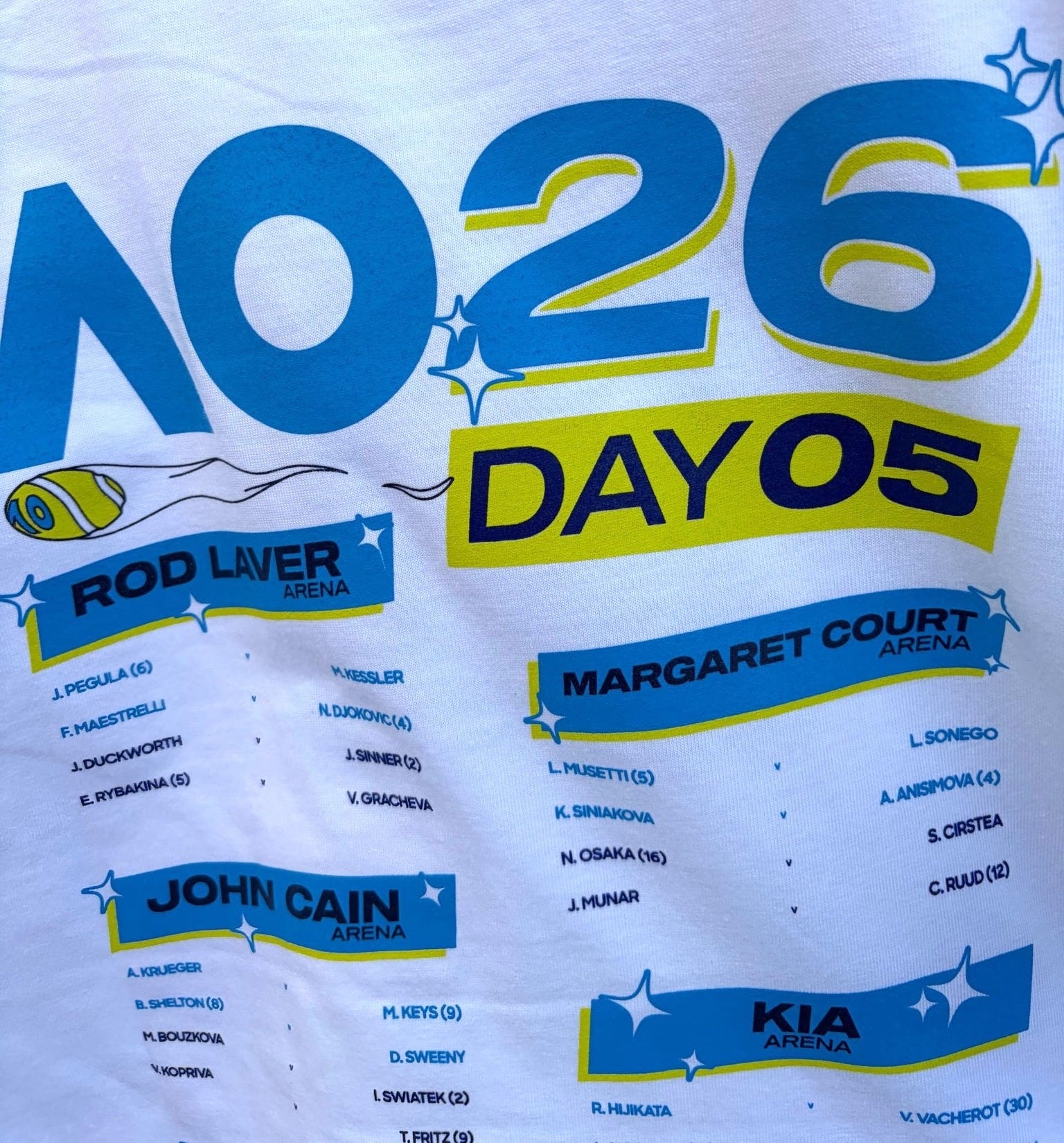
We’ve all been there—willing ourselves not to buy anything at a Grand Slam only to be sucked into one of the merch stores convinced that we can’t leave the grounds without at least three overpriced t-shirts and hats. Hell, at the US Open last year I found myself carrying around a seemingly simple sweater in the store tucked beneath Louis Armstrong, only to find in horror that it was almost $300 (I promptly returned it to its rack).
The desire to memorialize these big, often expensive tennis moments makes total sense, but most of the merch we’re sold to do so is generic—completely untethered to the specific memories of our day, or days, spent at a Slam.
Since 2025, the Australian Open has combatted this by offering highly specific t-shirts with the order of play on them. Given that the daily schedule is a moving target that isn’t confirmed until, at best, the late afternoon the day before, this is a seriously impressive feat and one I had to ask the Australian Open team about.
“We wanted to create a product that would be collectable and that you could only buy on-site on the day you came to the AO—the ultimate “I was there” memento ,” said Tiago Arguelles, the Australian Open’s Head of Retail.

The team was excited but nervous at first about pulling it off in such a short window. “Printing overnight and delivering early in the morning was something we’d never done before,” said Arguelles. “We also didn’t envision it becoming as big as it did.”
The match-day capsule includes the t-shirts as well as tote bags and pins that simply have the specific date on them and are manufactured ahead of the event. The prices are accessible despite being more special— the shirt retails for AUD $55 (USD $38) while the other items cost AUD $20 (USD $14).
Just as fans eagerly await the next-day schedule drop, so too does the retail team. “It usually comes out in the early afternoon but sometimes it can be late in the evening,” said Arguelles. “As soon as it’s announced we update the graphics of the shirt and send them to print overnight.”
There’s always the variable of players pulling out last minute due to injury, a potential t-shirt flaw that I expected the AO team to tell me they simply had no control over. Surely they wouldn’t be crazy enough to try to correct that too. But, it turns out, they are.
“There have been times when a player has pulled out with an injury and we’ve had to re-print the draw during the day in order to get a new delivery later in the day,” said Arguelles. Once the final shirts arrive on site, they have a dedicated team who distributes them to all the different shops and roaming carts around the grounds.
The response has been “overwhelmingly positive,” not just from fans but also colleagues at other Grand Slams and sporting events, said Arguelles. In the first year of the range, they sold 10,000 t-shirts and expect to see significant growth when they tally the numbers from this year.
“As we get closer to the end of the event, and there are some epic matchups on the back of the shirt, the demand grows,” said Arguelles. During last year’s semifinals, which included Carlos Alcaraz vs. Novak Djokovic, the order-of-play t-shirts sold out within an hour.
When too much optimism is a bad thing: The Taylor Fritz problem
Some players are held back by their lack of confidence but what happens if someone has too much? Enter Taylor Fritz.
He’s not cocky or arrogant, to be clear, but he’s openly discussed his at-times delusional optimism—a trait that’s in many ways worked in his favor over the years, helping him dig out wins when all signs indicate he won’t be able to do it. Certainly it helped him reach his career-high ranking of #4 in the world, one that many people were not only surprised by but weren’t sure he could hold onto as long as he did.
Now, though, that glass half full thinking appears to be clouding his judgment and getting in the way of what I think most people would agree is probably in his best interest: taking a real break.

Yesterday’s match against Lorenzo Musetti was a brutal watch. Everyone has their off days, sure, but this was more than that. Fritz was missing shots he almost never does and couldn’t reset the way he usually can to at least take a set. Musetti played great and did well not to let Fritz’s clear limitations affect his game, but the match never really felt competitive either.
The errors Fritz was making, including his weakened serve, were reminiscent of his downhill performance at Delray last year when his ab began bothering him, so when he took off his shirt to reveal two large swaths of KT tape on his obliques it all made sense. He’d been hinting at the return of his ab injury all week in press conferences and there was the confirmation, one coming at a time when he’s also battling chronic knee tendinitis.

I have a lot of respect for people who don’t retire frequently, either because they have the self-belief to think they can still turn it around or because they feel that as long as they can still vaguely get the ball in play, completing the match is the sportsmanlike thing to do, but that attitude can be taken too far. It certainly felt like it was in this match—why bother inflaming an injury further if there’s little to no window for you to secure the points at hand?
Earlier in the week, both Naomi Osaka and Jakub Mensik pulled out of the tournament due to ab injuries. Osaka’s situation feels quite similar to Fritz’s in that they both seem to put immense pressure on themselves to prove that they’ve still got it at age 28 and they’ve both struggled with this injury for a while now. For players nearing 30, I imagine it’s hard not to feel like the clock is ticking—like they only have a short window to achieve what they’d like to before the continued ascent of younger players gets in their way—but Osaka and Fritz have responded in very different ways.
Where she seems willing to take breaks and give her body the rest it needs, Fritz is almost allergic to the concept (men!). He played through pain for too long last year, he’s told the press a few times now as if a lightbulb was finally going off, only to follow it up with his desire to do the exact same thing now. I find it incredibly hard to believe that his coach and physio—Michael Russell and Wolfgang Oswald, two pragmatic men who he’s said have been vocal about him needing to take time off in the past—are truly on board with this approach. But at the end of the day, he’s the one in control.

Getting older isn’t easy, least of all in tennis and especially if you haven’t met the goals you’ve set for yourself, but ripping the bandaid off now and taking a few months to recover as other players have done seems like it will get Fritz much closer to tennis manna than trying to cling to the Top 10 no matter how much it hurts.
P.S. Are we finally going to get some upsets? This AO hasn’t been very headline-worthy yet but I think the next few matches could bring the chaos we so crave. It all starts tonight with the youthquake—Iva Jovic and Learner Tien taking on Aryna Sabalenka and Alexander Zverev, respectively.
Love notes:
Whoopsy daisy: After Carlos Alcaraz and Jannik Sinner were told to remove their Whoops during match play at the Australian Open, the Whoop CEO vented on Twitter about how absurd it was (the wearables are approved by the ITF). “Data isn’t steroids,” he wrote, and I tend to agree. I’ve asked the AO for clarity on why they’re not allowed and will report back if I hear anything.
Unpacking AO ‘fits and more: I had the best time chatting with my Substack pal Lee Glandorf about growing Hard Court, tennis sponsorships, and the AO ‘fits that I liked best. I also love her take on the Naomi Osaka dress uproar at the end of the newsletter—that whole situation was a great reminder that bad people really can’t help but tell on themselves.
Jannik Sinner has range: Can we talk about the pure comedy that comes with Jannik Sinner doing anything other than crushing balls on a tennis court? I love that he’s one of the best athletes in the world but has grandma energy in every other facet of life. Just watch his latest vlog or this clip of him trying to fix a TV to see what I mean.
Eliot Spizzirri should media train us all: Eliot Spizzirri is definitely one of the revelations of the Australian Open. Yes, he tussled with Sinner, but I’m also just impressed by his maturity and composure—with the way he navigates this press conference, you’d think he’s been playing on big stages for years. My country is a shitstorm right now but at least the “kids” are alright.
Thanks for reading! If you have tennis news or tips to share, email jessica@hard-court.com. For regular updates, follow Hard Court on Instagram.
What is the argument against allowing WHOOP bands? I'm having a hard time understanding the possible justification.
Also thanks for the warm AO content on this very snowy weekend in NYC!
Are the tees available for purchase online? They look really cute and are something I could add to my collection!