How Elite Eleven Sporting is quickly filling a void in Australian tennis wear
With versatile kits at affordable price points and a growing WTA roster, Elite Eleven is building tennis credibility fast.
I first noticed Elite Eleven Sporting while watching Eastbourne last year, when the 19-year-old Maya Joint (Australian by way of Grosse Point, Michigan) played in an emerald green tennis dress with an athletic zip top from the brand that made her red hair pop and was reminiscent of the hip running brand District Vision, but with a more feminine edge.
The Australian athleisure brand, which was founded in 2014 but didn’t start selling tennis clothes or sponsoring athletes until 2022, is making under-the-radar inroads into the sport—acting as the apparel sponsor and dressing the ball boys for several of the lead-up tournaments to the Australian Open and sponsoring players like Joint, Kim Birrell, Talia Gibson, and Ellen Perez, among others. Daria Saville, who doesn’t wear the brand officially, recently named it as one of her top three tennis brands in a video on Instagram.
“I was really passionate about getting us involved in professional sports when I joined four years ago, and after COVID [when everyone was living in athleisure] the brand really took off and we had the resources to start experimenting with it,” said Adrian Zarafa, the brand’s creative lead. As a tennis fan himself, it was the obvious sport to start with for all the reasons other brands have mentioned in past Kitted features: “With tennis, you’re dealing with one person and one manager—you really get to build a relationship with the player and it’s a lot more personal.”
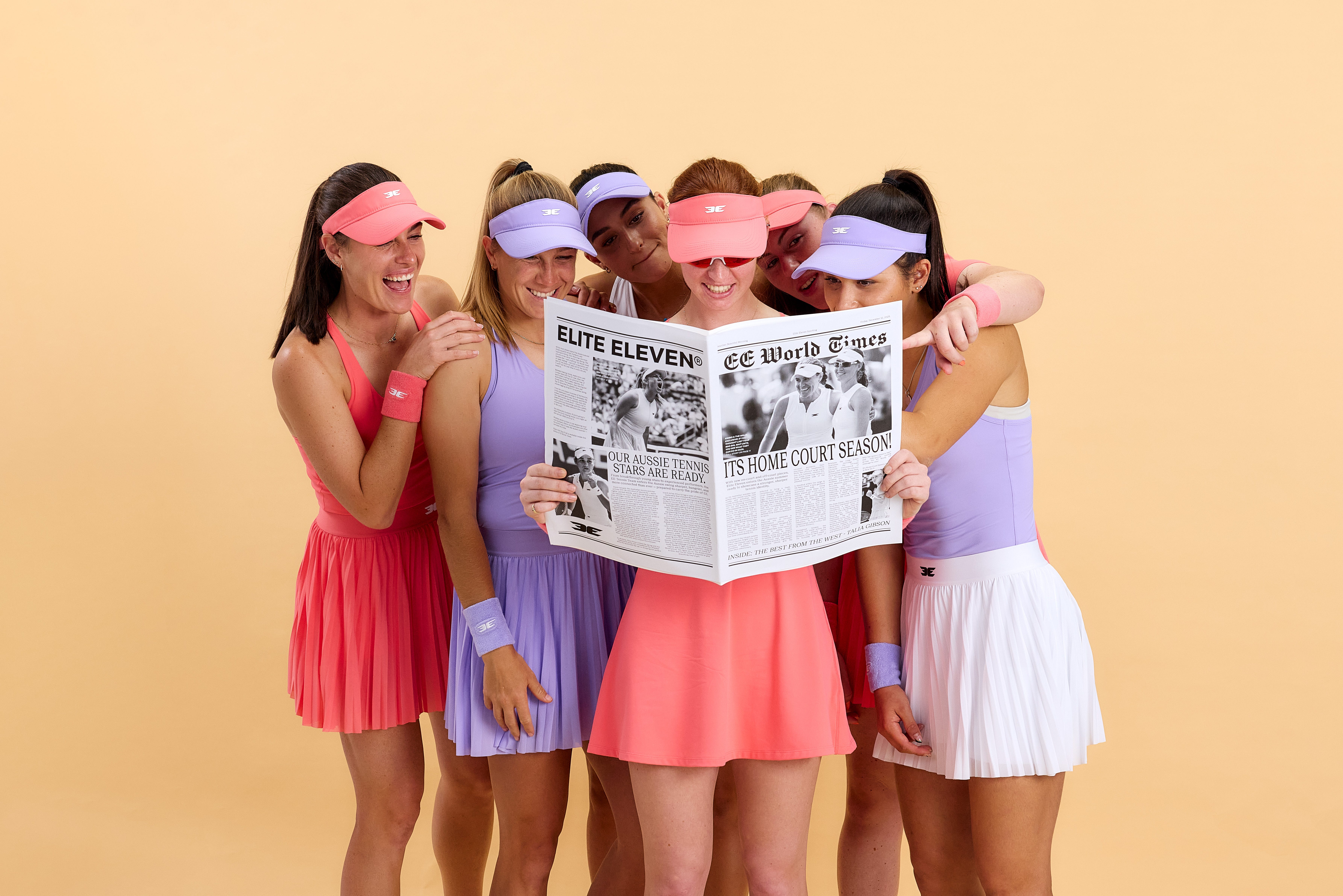
Although it was Joint’s Eastbourne kit that first piqued my interest in the brand, a campaign video it launched this past December cemented Elite Eleven Sporting as one to watch. Narrated like a coming-of-age film from the ‘90s, it features three different personas, including the “aspiring athlete” Joint, navigating an extremely upbeat universe called “EE World,” where, the caption copy reads, “Every version of you has a home.”
“I’m a ‘90s baby, so I grew up watching Disney movies and all that sort of stuff, and I really wanted it to feel like a trailer for one of those family-oriented Disney movies,” said Zarafa. “World building is extremely important to us, and then we focused on the three personas that make up our audience,” which, alongside Joint’s aspiring athlete, include the “pilates princess” and the everyday guy who lives in tracksuit pants and hoodies.
Filmed right after the US Open, it was the brand’s highest production level campaign to date and signaled a new phase for the brand—one bent on international expansion, greater brand awareness, and a larger tennis roster. Below, I break down the key elements that have made Elite Eleven Sporting a brand to watch.
Helping Aussie players shine
Outside of Alex de Minaur, who recently jumped from Asics to become Wilson’s star ATP player, today’s Australian players aren’t ranked highly enough to be appealing to tennis’s biggest brands. Ajla Tomljanović, for example, wears Penguin (a brand that needs a serious refresh) while Alexei Popyrin is signed by the newer tennis entrant Psycho Bunny. Zarafa and his colleagues at Elite Eleven are hoping to give their fellow Aussies a good option in spite of this reality.
“I felt like the global tennis brands weren’t really giving Australian players the time of day,” he said. “Being able to now work with those players and give them a platform to help get their names out there has been really cool.”
The first player they signed in 2022 was Alexandra Bozovic after Zarafa reached out to her via Instagram. Unsponsored at the time and ranked in the 300s, she was eager to work with the brand and help them out by wear-testing samples and sending feedback.
“After that it just became word of mouth on the WTA Tour, where a lot of them are very interested in fashion,” said Zarafa. That led to interest from Birrell, who Zarafa describes as one of the most respected people on tour. “I feel like you would struggle to find a person that doesn’t like her, so to have her promoting the brand was amazing.”
Birrell happens to share a manager with Joint, a rising star who Zarafa had his eye on in 2024. “At the time, she was just starting to skyrocket so she had a few offers on the table,” he said. “To have her choose to sign with us was amazing.”
Currently they only sponsor one ATP player, world No. 384 Marc Polmans, but they’re hoping to expand their male roster in the future. The challenge is that, after De Minaur, the rankings drop off quite a bit, said Zarafa.
Although it’s hard to explicitly quantify whether or not sponsoring tennis players directly leads to sales, Zarafa says there’s been lots of anecdotal evidence that it has along the way.
Just a few weeks ago, before their latest tennis collection dropped, the brand’s co-founder Benn Martiniello got a Slack message from a retail associate who works in their Bondi store that read, “Hi, Benn, we have had multiple girls phone us regarding the purple top and skirt products Kim Birrell is wearing in the Brisbane International. Are there any potential plans to release a new tennis collection?”
“We don’t get messages like that every day obviously, but I think amongst the tennis community in Australia it’s really helped with brand awareness,” said Zarafa.
Competitive pricing
One of Elite Eleven’s biggest differentiators in the tennis apparel and athleisure landscape is its price range. A tennis skirt ranges between $50-73 AUD ($33-50 USD) while a tank ranges between $40-65 AUD ($27-42 USD)—compare that to brands like Adidas, Nike, Wilson, or Lululemon and you’ll see a significant difference.
“Our brand is all about offering pieces at an affordable price point, especially with tennis items, because the legacy brands involved are quite expensive, and tennis is an expensive sport in general,” said Zarafa. “Even the casual players today want to be kitted out and look like a million bucks while they’re playing tennis, but it can be expensive to do that.”
Giving consumers a cheaper option that still looks and feels high quality has been key to the brand’s mission, and when I texted an Australian friend to see if that latter part holds true, she responded, “Honestly yes, I love my pieces from them—they feel great and hold up well.”
“People tend to equate higher price points with better quality and we want to show that, at least in some cases, there are brands who come in at our price point that sell products that are just as good, if not better, than some of the more expensive brands,” Zarafa said. (Ed. Note. I’ve heard from many readers who love Uniqlo’s athletic wear much more than pricier tennis brands.)
Versatile designs
Although Joint’s custom dress at Eastbourne stood out, nothing about Elite Eleven’s designs feels over the top. They’re not reinventing the wheel with silhouettes but focusing instead on proper fit and miniscule details, like the cut of a t-shirt or tank. Color is where they play most, with their athletes at this year’s Australian Open wearing tank dresses and pleated skirt sets (versions of which are available for sale) in coral and light purple.
“Our brand aesthetic is quite minimal—you’ll never see anything too loud from us when it comes to tennis wear because it’s just not our vibe,” said Zarafa, who’s also (like me) allergic to all-over prints. “I’d rather make a difference in the details—the cut of a dress or the material we use.”
One of the brand’s other core tenets is designing apparel that isn’t purely for the court, he added, noting that they want even the pieces their pros wear to be items they could also wear to run an errand or to a casual hang with friends.
The players they sponsor have a big hand in the final designs as well. For this year’s Australian Open, Joint co-designed her kit—a pink tank dress with thin straps and a matching visor—after messaging Zarafa one night on WhatsApp from Croatia last year with an idea. “Literally right after wiping someone off the court, she went back to her hotel, sketched this out, sent it to me, and then played another match the next day,” he said.
Her idea, although quite basic, ended up setting the tone for the whole collection. “All it takes is someone like Maya, who feels comfortable enough to pitch an idea, to set us on the right path,” said Zarafa.
*
Looking ahead, the brand is hoping to break into the US market. Its website ships internationally and they held a pop-up in New York’s Soho neighborhood a few months ago to gauge interest. Still, a comment that one of Elite Eleven’s founders made to Zarafa once sticks with him: “We need to dominate our own backyard before trying to dominate the rest of the world.”
With 18 stores across Australia and 400 employees across their headquarters, retail spaces, and warehouse, they’re certainly on the right track.
Thanks for reading! If you have tennis news or tips to share, email jessica@hard-court.com. For regular updates, follow Hard Court on Instagram.


Stellar coverage! The pricing angle is whats really compeling here, not just for accessibility but for changing the whole economics of player sponsorships. When mid-ranked Aussies can secure apparel deals without sacrificing quality, it shifts leverage away from legacy brands. I've seen similar in running where boutique brands undercut Nike by targeting specific geo markets first, buidling loyalty before going global.
Love this! Maya’s look definitely caught my eye, love they let her run with things. I need the intel on Priscilla Hon’s Upside kit next!!