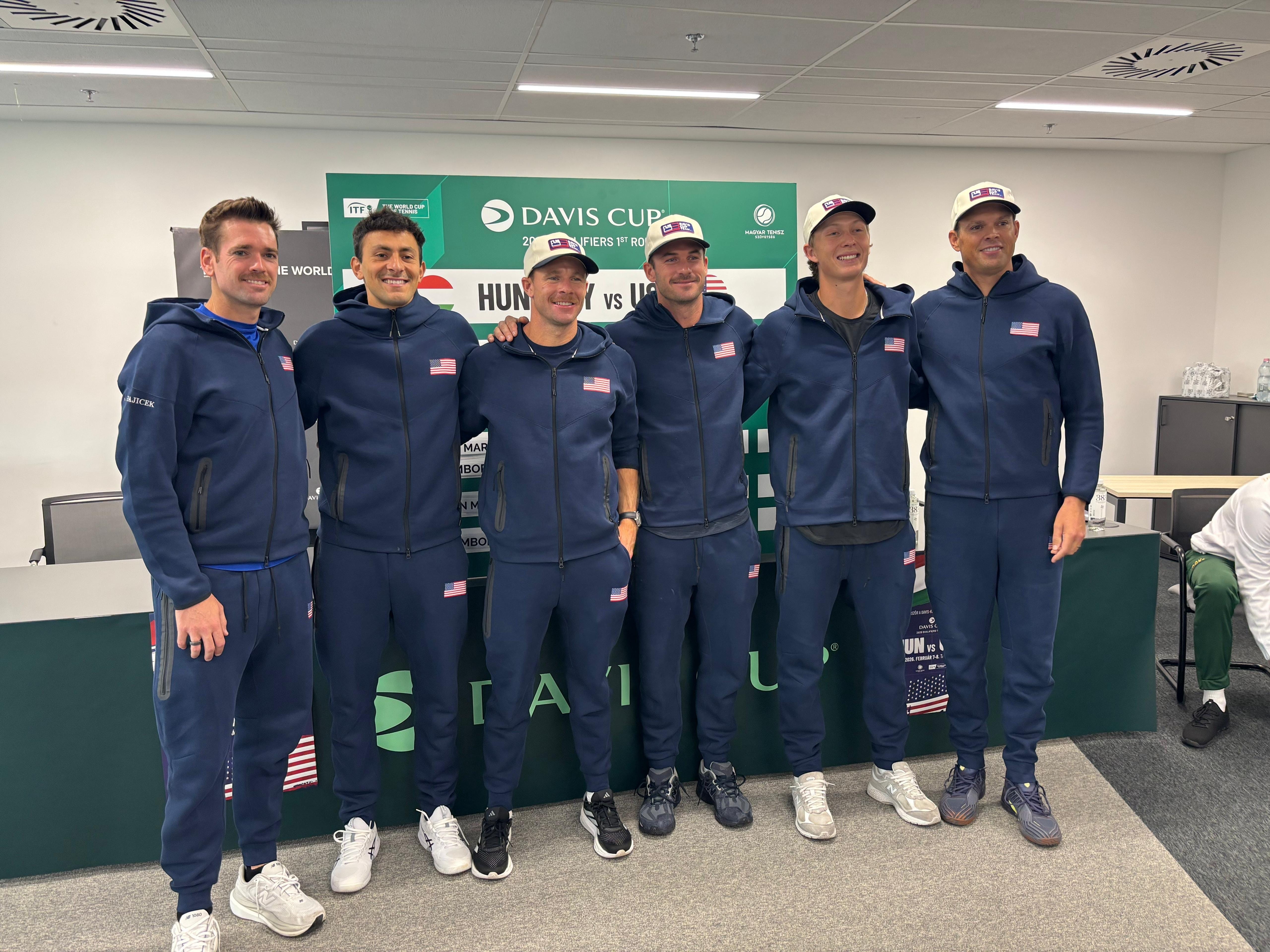
Christian Harrison and Ethan Quinn on their Davis Cup debuts
I spoke to the Australian Open doubles champion and rising American about their first Davis Cup call-up.

If you’re an American men’s tennis player, playing for the Davis Cup team is something of a rite of passage. By all accounts, it’s like a traveling, non-toxic fraternity—one where the self-interest of playing an individual (or, at most, two-person team) sport is set aside for the greater good.
So when Christian Harrison (doubles No. 11) and Ethan Quinn (singles No. 68) got the call to play the first Davis Cup tie of the year against Hungary in the city of Tatanbánya, it was a no-brainer. They’re joined by fellow first-timer Emilio Nava and vets Tommy Paul and Austin Krajicek.
“We have such a strong group of guys, so being the twelfth-ranked American, I didn’t know when that time would come,” said 21-year-old Quinn over the phone the day before the draw ceremony. “So the minute I got the call I was in, because I don’t know when the next opportunity will be.”
Harrison was brought in to replace Rajeev Ram and didn’t find out until the first week of the Australian Open that he’d be going. “I always felt like if I could win enough matches and be consistent then the opportunity might come up,” said the 31-year-old, who’s struggled with multiple injuries and had eight surgeries over the course of his career. He’s certainly been winning enough matches lately, including his first Grand Slam title at the Australian Open with partner Neal Skupski.
“It feels kind of surreal,” he said a week after the win. “I’ve worked hard to be in this spot and I want to keep doing everything I can to have more of these moments.”
Going from playing on hard courts in the Australian summer straight into a cold winter in Hungary where they’re competing on indoor clay is a particular kind of whiplash. The day after the trophy ceremony, Harrison caught an 8:30 am flight to Budapest. Quinn had a little more time to prep back home in Florida.
In his first main-draw appearance at the Australian Open, he made it to the third round of a Grand Slam for the second time in his young career, beating No. 29 Tallon Griekspoor and pulling off a surprise upset over No. 52 Hubi Hurkacz, a former world No. 6 who entered the tournament in strong form after returning from injury.
“Having a really strong preseason with [the other players in Florida] was what allowed me to succeed while I was in Australia,” said Quinn. “I didn’t have the easiest of draws so being able to win my first two matches in straights really gave me a lot of confidence going into the rest of the year.”
The Florida clay courts that Quinn practiced on don’t quite compare to the rare indoor courts at the sports complex in Tatabánya, where the clay is layered over a wooden platform that the players say feels a little different as you slide. He and Paul’s strength and conditioning coach, Franco Herrerro, made the trip with them, helping them adjust their footwork.
Harrison, for his part, will be playing doubles with Krajicek for the first time. They’ve spent this week getting into a good rhythm and learning each other’s patterns. “Austin’s very accomplished so his game speaks for itself and he’s very easy to play with,” said Harrison. “But the more time you spend together on court, the more you realize what your strengths will be as a team—how to react to each other’s shots, adjust to their shot quality, and play to the right targets to set your partner up well.”
Both players said the team environment leads to an almost collegiate-like experience. Nearly everything is done together, including with the physios, massage therapists, doctors, and stringers—team breakfast, team practice, team coffee breaks, team dinners, team treatment, and a regular tradition of team card games at night.
That translates over to support during competition, which begins tomorrow.
Asked if they feel more pressure playing for their team and their country, Quinn said that if he hadn’t played in college at the University of Georgia for three semesters before going pro, he’d probably say yes. “When I had my first few matches in college, I was terrified because I was playing so much for my teammates and didn’t want to let them down,” he said. “I eventually realized that the only way I can do well for the team is if I do well for myself, and so that’s given me a different outlook going into the Davis Cup.”
“I’ve been lucky to have such a great group of US teammates that are super supportive and bring out a lot of positive energy,” said Harrison, who also made his United Cup debut earlier this year. “I think that brings out the best in all of us when we step on court.”
Quinn is getting an extra boost from Paul, who he describes as a big brother figure and mentor, someone who—along with the other top Americans—has given Quinn and his peers guidance on how to navigate the very unique world of professional tennis.
But with Paul, there’s also a lot of good faith teasing, including his chosen nickname for the team, the “Big Babies.”
“Sometimes I think that he just came here [last minute] to give me the full rookie experience,” laughed Quinn.
Thanks for reading! If you have tennis news or tips to share, email jessica@hard-court.com. For regular updates, follow Hard Court on Instagram.


