It’s the calm before the chaos and, because “god” or whatever loves to torture me, I am sick on top of all of my other ailments. But I’ll set aside my seemingly karmic payments to focus on some of the things I’ll be watching over the next three weeks.
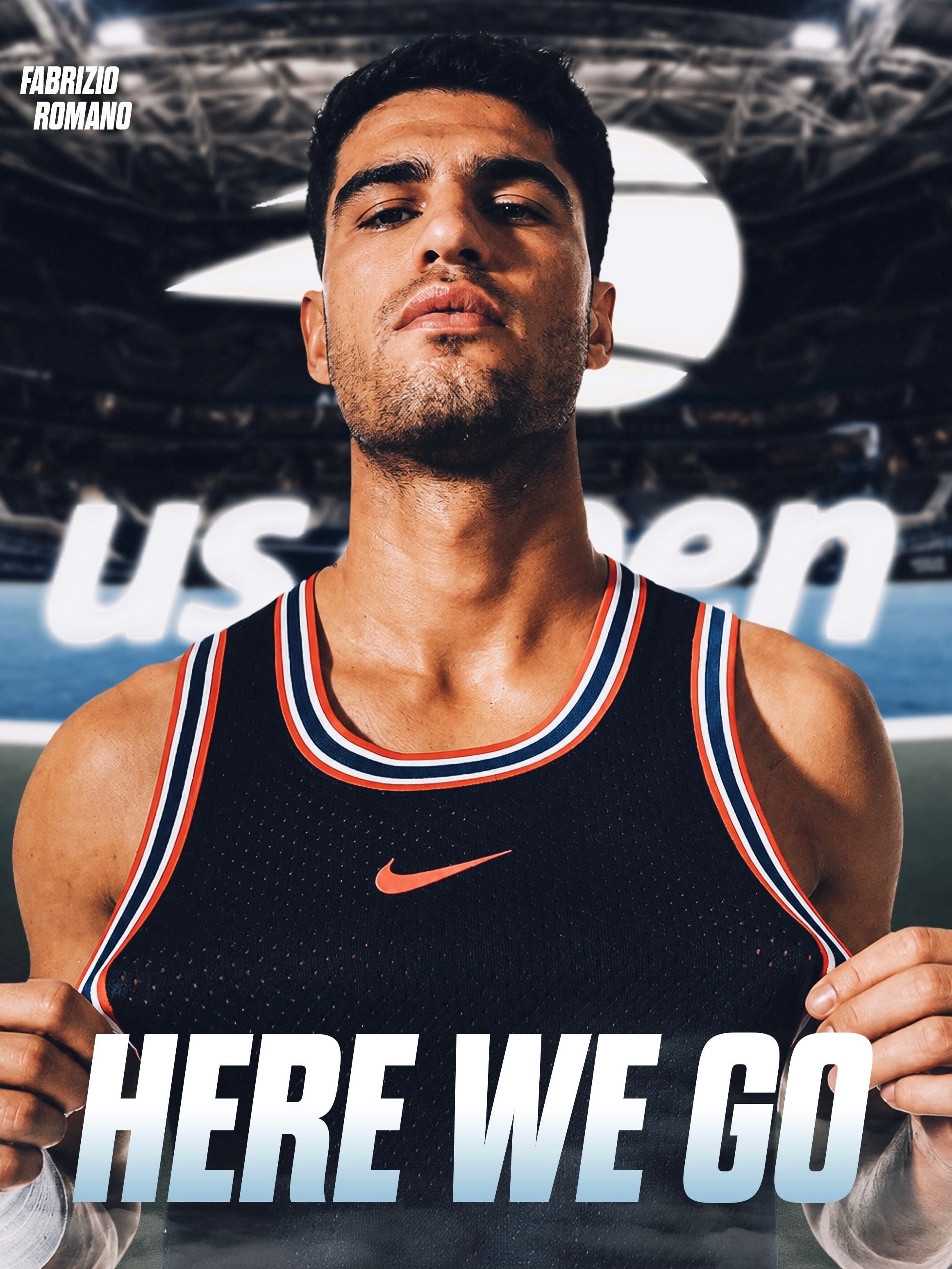
Carlos Alcaraz announced his return yesterday via Fabrizio Romano, an aura-depleting move in the words of my friend James Hansen, and simultaneously dashed the hopes of many top players who fantasized that, with him out and loose chatter about Sinner being on the fence, they might finally have a chance. Of course, Alcaraz’s form is likely to be rusty and playing best-of-5 after a long break isn’t easy for anyone, so, fret not, there is still hope for the underdogs.
Nevertheless, I think we’re all thrilled that the tour’s resident golden-retriever-with-a-killer-instinct is back.
One of the things I’ll be tracking closely during this period is the deal-making going on off-court. The US Open is prime time for agents and brands to really ramp up whatever conversations they’ve been having about new sponsorships, particularly on the apparel front. Most announcements won’t be formally made until the new year, but I’ll have my ears alert for developments with top players like Ben Shelton and Jessica Pegula. Karolina Muchova and Paula Badosa also have deals up this year, and some brands, like Adidas, are planning to prioritize young guns like Rafael Jodar, who won’t come cheap, leaving less room for the veterans.
Those negotiations can also have consequences on court. Several agents I’ve spoken to over the last few months have told me that contract negotiations—whether a deal is up for renewal or a player is pursuing a new one—can actually affect performance. “They definitely feel the pressure, and you can see it in their results at times, especially if they were already starting to hit a rough patch,” one agent told me.
I’ll also have a front-row seat to the US Open’s nascent creator program and am very curious to see how that unfolds in real time. I’m all for credentialing creators and bringing them into the fold, but I’m less convinced they should automatically be given the same permissions as traditional media. I think there’s a better middle ground that preserves the access journalists need to do their jobs, while creating dedicated opportunities for creators to engage with players in ways that make sense for their platforms.
Then there’s the hubbub of activity, with next week becoming increasingly bloated with pre-tournament events—only about a quarter of which are worth actually attending. Of note are, of course, Hard Court’s first cocktail party for key figures across tennis and fashion (it will be the best party of the week); a seated LALO Tequila dinner hosted by ambassadors Amanda Anisimova and Zizou Bergs; a Dobel Tequila event where you can play padel with Taylor Fritz; a Lululemon dinner hosted by Frances Tiafoe; a Moroccanoil event fêting a new WTA brand ambassador; and the World Team Tennis party at Rockefeller Center. Everything else is just noise.
If you’re in the industry, buckle up, and if you’re a fan, I hope you’ve found a way to experience the tennis that’s not cost-prohibitive. Watching it blissfully from your couch really isn’t so bad, I can assure you.
Below, a few more things I’m thinking about as the circus gets underway.
Beauty moves in
Earlier this year, I wrote about what seemed like a fairly obvious missed opportunity in tennis: Where are all the beauty brands?
Fashion brands have flocked to the sport as its cultural relevance has grown, but beauty has yet to make the same kind of push. Sunscreen has been one of the few categories to establish a consistent presence, with brands like La Roche-Posay and ISDIN building partnerships across some of the sport’s biggest tournaments. But beyond sun protection, very few beauty brands have made a meaningful investment in tennis.
The Australian Open has been the most notable exception. Its partnership with Australian beauty retailer MECCA has grown to include a store on the grounds, beauty services and other activations that treat a tennis tournament not simply as a sporting event, but as a place where people think about how they look and what they wear. There have been other signs of movement, too. The Miami Open has brought in brands like INNBEAUTY Project and Moroccanoil as skincare and haircare partners in recent years, suggesting that at least some brands are beginning to look beyond SPF. Next week, a WTA top-five player will also announce a new partnership in the hair category.
At the US Open, Dove is making its own bet on that opportunity.
The Unilever-owned brand is returning for its second year as the tournament’s Official Underarm Sponsor, but its presence around the Open will be considerably larger this time. Photographers Tyrell Hampton and Johnny Criollo of Watching New York will capture fan style around the grounds for Dove’s social channels, while comedian Carly Aquilino will interview spectators about the looks and conversations generating buzz around the tournament. An on-site space will give fans a place to cool down and touch up with Dove deodorant and other beauty products, and for the women’s final, the brand will open tabs at 10 women-owned sports bars around the country. Dove’s 2026 campaign also includes a social content series with the USTA.
“Last year reinforced that Dove has a very natural and credible role at the US Open,” Kevin Tolson, head of Dove and SheaMoisture Deodorants at Unilever, told Hard Court. “There’s the obvious functional connection to sweat and performance, but what became even clearer was that the tournament is about much more than what happens on the court. Fans are thinking about how they’re participating in the culture surrounding the tournament, and this includes what they’re wearing.”
That last part is what makes Dove’s strategy particularly interesting. There is perhaps no sporting event in the U.S. where the spectator has become as much a part of the cultural product as the US Open. People plan outfits for it. They post about what they eat and drink. Brands build elaborate spaces designed as much to be photographed as experienced. The crowds in the stands have become their own form of entertainment, dissected across social media alongside the matches themselves.
For Dove, that creates an especially neat overlap between performance and style. Deodorant has an obvious use for someone spending hours walking around Flushing Meadows in late-August heat, but its Dove Invisible product, which is designed not to leave white marks on clothing, also gives the company a reason to enter the conversation around what those spectators are wearing.
“You want someone to understand almost immediately why your product belongs there,” Tolson said. “That functional connection is what gives us permission to participate in the broader cultural conversation around the tournament.”
Dove admittedly sits somewhere between beauty and personal care, and deodorant isn’t necessarily what comes to mind when you think about beauty’s opportunity in tennis. But that may also be part of what makes its strategy instructive. The company isn’t trying to manufacture a connection to tennis simply because the sport is popular—it can sell sweat protection and a fashion-adjacent product benefit at the same time.
It also reflects a broader change in what sponsors see when they look at the US Open crowd. Fans were once valuable to brands primarily because they constituted an audience. Increasingly, they are also participants in and distributors of the culture being created around the event. That helps explain why so much of Dove’s expanded strategy centers around the people in the stands rather than the players on court.
“So much of culture around sports now is shaped by the people experiencing it in real time,” Tolson said. “We didn’t want Dove telling fans what was interesting about the US Open. We wanted fans to tell us.”
For years, sunscreen was the most obvious way for beauty brands to enter tennis. Between MECCA, the growing beauty presence in Miami, Dove’s expansion in New York and another player deal coming next week, there are finally signs that it won’t be the only one.
New mediums
Paige Paul and Ayan Broomfield have both recently joined Substack, part of a broader move among creators toward platforms that allow them to communicate more directly and at greater length with their audiences. Paul is already three issues in with By Paige Paul and I appreciated the candid reflections in her first issue—there’s a lot of mythology that follows her, and she faced it head on. Broomfield, a former NCAA champ, has yet to publish but said in a Note that it will extend beyond tennis into fashion, beauty, travel, life on tour and building businesses. The hope, she said, is that it feels like a group chat for her audience.
Meanwhile, veteran tennis journalist Jon Wertheim is experimenting with an even more direct format for the US Open: text messages. He’s launching an SMS service that will deliver updates from him throughout the tournament straight to subscribers’ phones.
The launches are different, but the impulse behind them feels similar. At a moment when social platforms increasingly dictate how (and whether) content reaches an audience, people who have spent years building followings there are looking for ways to own a more direct relationship with them.
Thanks for reading! If you have tennis news or tips to share, email jessica@hard-court.com. For regular updates, follow Hard Court on Instagram.
Hard Court is built on independent reporting and analysis. If you refer to our content in your work, please cite the source. I really appreciate it!


Hard Court’s first cocktail party 😮