Tennis has a merch problem—and it’s bigger than one stolen design
An illustrator’s work appearing on Monte-Carlo Masters merchandise without permission points to a deeper issue: tennis’s fragmented retail system leaves no one clearly in charge.

When an illustrator sees her work show up on official tennis tournament merchandise without permission, it’s easy to treat it as a one-off—a bad actor, a sourcing mistake, an unfortunate oversight
But in tennis, it’s representative of a larger problem.
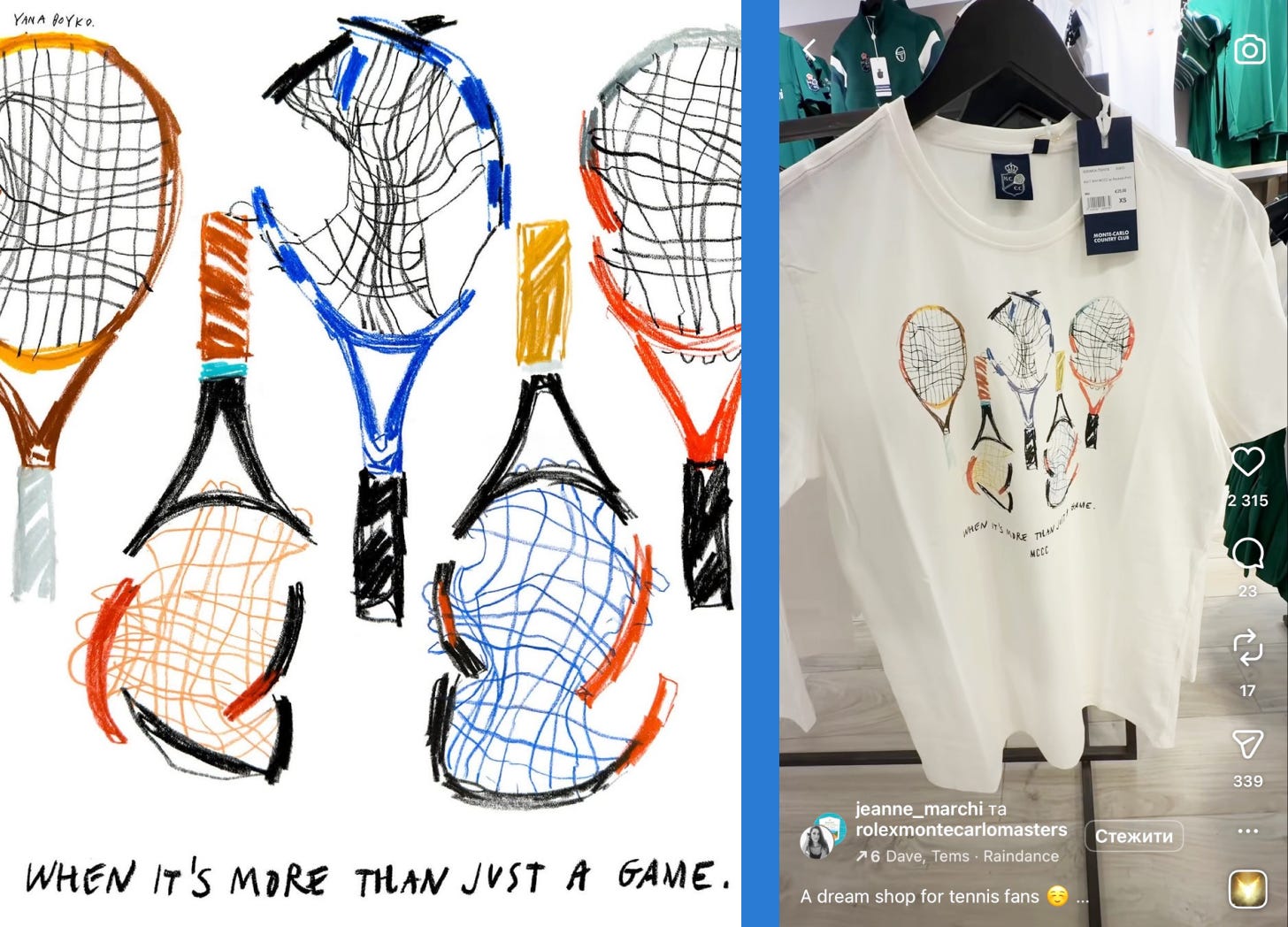
When Yana Boyko realized her illustration of tennis rackets had been printed on Monte-Carlo Masters merchandise without her consent, she did what most creators do today: she posted about it. The tweet quickly began to circulate, drawing attention to the design and raising questions about how it ended up on official tournament merch in the first place. The merchandise itself is branded as being sold by the Monte-Carlo Country Club, where the event takes place, but it’s unclear who actually produced it.
She then reached out to the tournament directly. The ticketing department said the issue was “outside their jurisdiction,” apologized, and said her message would be passed along. When she asked who exactly would be handling it, and when she could expect a response, she didn’t hear back.
Boyko, who created the illustration while living at home in Ukraine and is now based in Portugal, said she had previously turned down requests to buy the rights to the work. She also doesn’t know how it was sourced in the first place, though it was likely stolen from her Instagram.
That ambiguity—where the design came from, who approved it, who is responsible—isn’t an anomaly. It’s the result of how tennis operates.
The ATP’s licensing and retail team said they were not involved in the creation of Monte-Carlo’s merch and I’ve reached out to the tournament and country club for comment.
A symptom of a larger problem
For all the talk about tennis leaning into fashion, the sport still doesn’t have a centralized merchandising infrastructure. The ATP runs more than 60 events globally, but it doesn’t actually control what’s sold on-site at most of them. Retail rights are held at the tournament level, often executed by different partners, with varying levels of investment, oversight, and taste.
As one ATP executive put it to me earlier this year, the system is “fragmented”—a patchwork of operators where some events treat retail as a priority and others, in his words, see it as “one of the last areas to look at.” The result is inconsistency at best, and at worst, a lack of clear accountability when something goes wrong.
Even the ATP’s own licensing and retail function is relatively new, built from scratch over the past year. There are early efforts to centralize—an e-commerce platform, clothing brand collaborations, ambitions to bring ATP-branded stores on-site—but for now, control remains diffuse. Any attempt to standardize runs into a familiar set of obstacles: existing brand exclusivity deals, tournament autonomy, and a system that was never designed to operate as a unified commercial machine.
That’s often where problems like this bubble up.
Because while tennis is still figuring out how to organize its retail ecosystem, the market around it is filling the void in a haphazard way. Print-on-demand platforms, third-party vendors, and low-friction manufacturing mean that imagery can be turned into product almost instantly, often without oversight, and sometimes without permission.
And as tennis grows in popularity, there’s more art available to steal.
For a long time, tennis didn’t really have this problem. Its visual identity was narrow, controlled, and—outside of a few legacy brands—not especially in demand. That’s changed. The sport is producing more culturally impactful imagery, driven by players, designers, and independent creators who understand how to translate tennis into something people actually want to wear.
But, as I often discuss here, the infrastructure hasn’t caught up.
So you end up in a strange middle ground: tennis is generating cultural value, but it doesn’t fully control how that value is commercialized, or by whom.
The risk isn’t just to creators like Boyko, who are left chasing answers across departments that may or may not be responsible. It’s also reputational.
To a consumer, there’s no distinction between a tournament-run store, a licensed vendor, or a third-party operator working under an event’s umbrella. It all reads as “official.” When the product is bad—or worse, when it appears to be using unlicensed artwork—that reflects on the sport itself, regardless of where the breakdown happened.
The ATP, to its credit, seems to understand that now. The early moves—building direct-to-consumer channels, experimenting with collaborations, trying to establish a more cohesive product identity—are all steps in the right direction. But they’re trying to repair a system that wasn’t built for this kind of centralization.
As tennis continues its push into fashion and lifestyle, that tension is only going to become more visible. The imagery is getting stronger and the demand for tennis merch is there. But the question of who owns it, who protects it, and who ultimately profits from it is still very much unresolved.
Thanks for reading! If you have tennis news or tips to share, email jessica@hard-court.com. For regular updates, follow Hard Court on Instagram.


