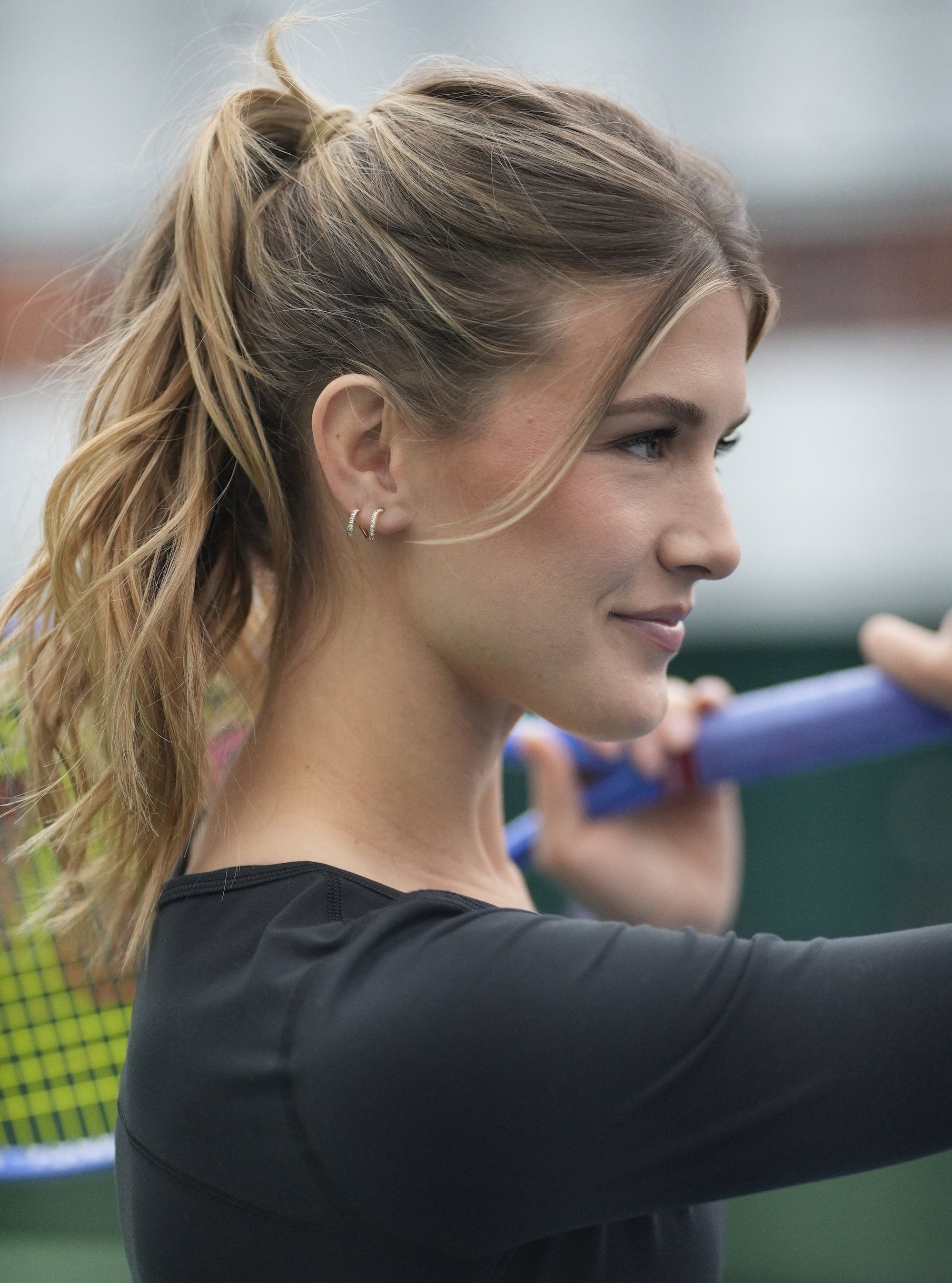
With 5 new ambassadors, Mejuri is leading the charge in tennis jewelry
Unpacking the brand’s performance jewelry strategy with its CBO and one of its new ambassadors, Genie Bouchard.
Can a jewelry brand be a tennis brand, too? In 2026, anything’s possible.
Mejuri, the midmarket Canadian fine jewelry brand that brought on Emma Navarro as an ambassador last year, is forming something of a case study with its nascent PLAY line, a collection of jewelry designed with performance in mind. The brand announced today that it’s deepening its investment in the sport, bringing on five new ambassadors that span all stages of a tennis career.
There’s Vicky Mboko, the rising Canadian star who jumped from world No. 333 to No. 18 and beat four Grand Slam champions at the National Bank Open last year; McCartney Kessler, the American girl-next-door-gone-fiercely-competitive who’s currently world No. 30; Stanford University player Valerie Glozman who made her US Open main draw debut last summer; 16-year-old British prodigy Hannah Klugman; and last but not least, Genie Bouchard, the Canadian icon and former world No. 5 who retired this summer and now plays professional pickleball.
“It was very intentional to bring visibility to all those different phases of a tennis career—to really show the full embodiment of what it’s like to be a successful tennis player,” said Mejuri’s chief brand officer, Jacob Jordan. “We’re trying to bring more attention to that journey and how challenging it is.”
Jordan knows a little something about tennis, and it isn’t (like many executives) just that it’s hot right now. A lifelong player, he picked up a racket when he was six and was nationally ranked until he stopped playing seriously in college, though he jokes that those accolades are long past the statute of limitations. “Tennis has meant so much to me for a huge part of my life, so it’s not about just going out and securing the most popular player in the world, we’re trying to get involved in the sport in a way that is authentic,” he says.
Genie Bouchard told me she was drawn to the company because the message of PLAY aligned with one she’d been trying to send her whole career—that you can play a sport, work hard physically, be a so-called “tomboy,” and still embrace your femininity and desire to look stylish. “I’ve told every sponsor I’ve ever had, if I feel good when I walk on the court, I’m going to play well, and I will find a study that backs this up [laughs] because I know from experience that it helps.” (There are in fact some studies that show this.)
Along with the new ambassadors, the brand is releasing two new earrings inspired by the tennis bracelet, a style made famous by Chrissie Evert. There’s the Drop Shot Earring, a short tennis strand with a bit of swing to it, and the Double Tennis Hoop, a single earring disguised as two that’s meant to evoke a tennis bracelet threading through the ear. Designed to stay put and resist sweat, they’re made in sterling silver with lab-grown sapphires or a made-to-order option of 10k yellow gold with lab-grown diamonds, with prices ranging from $228-$248 for the silver pieces to $698-$998 for the gold versions. But the ambassadors will be wearing pieces from Mejuri’s entire collection, which includes more affordable pieces.
“You sort of see jewelry come into play when players reach into their bag after a match to put on their watches, but that can feel very superficial,” says Jordan. “I want the players to really wear these pieces, it should be something that makes them feel a little bit more like them.”
Over the last year, jewelry brands have been especially bullish on tennis. The trendy lower-priced brand Gorjana announced a roster of athlete ambassadors, dubbed the Gorjana Sports Club, with Jessica Pegula (a brand partner since 2023) as the leading face. Brilliant Earth, known for ethically sourced fine jewelry, brought on Madison Keys as its first athlete ambassador, selling a $1450 medallion necklace she designed. Paula Badosa launched her own jewelry line called “Aces” with The 1916 Company, a luxury watch and fine jewelry retailer. And that’s just the tip of the iceberg (diamond?).
“I’ve noticed it,” Bouchard tells me of the trend, which she attributes to the post-Covid racket sports boom and the movie Challengers. “There’s this whole tenniscore style that exists now that we never would have talked about 10 years ago.” Plus, she says, the individuality of tennis compared to other sports which have more restrictive team dress codes is a huge appeal. “I’m my own brand, every tennis player is their own brand, and so these details can stand out a bit more.”
I’ve at times called into question the ROI of some of these jewelry partnerships, wondering if the average tennis fan cares enough to, say, put down a thousand dollars for a necklace designed by a player they like or if the brands involved are making it clear enough what their players are wearing, when, and swipe to buy here. But given that most tennis players, including men, wear some form of jewelry on the court, it’s a merging of worlds that makes sense if executed correctly.
Mejuri is hoping that storytelling around the player’s lives on and off-court will give them an edge. Yes, every ambassador will have their own curation of jewelry on the brand’s website, but they’re also hoping to showcase more of their everyday lives. “We want to bring awareness and exposure,” says Jordan. That means showing all of the travel, the practice sessions, the late nights in hotels—the “360-degree story of what it means to be a tennis player.” Outside of a few designated photoshoots a year, much of that content will be captured by the players’ teams.
Bouchard, who’s worked with many brand partners over the years, says that she’s learned to weed out the ones that don’t feel truly aligned with her values. “I’ll admit, I’ve done some one-off partnerships in the past, like posting for a sports betting company or teeth whitening company, that just don’t feel great,” she says. When she met with Mejuri, it was evident to her that they really loved tennis. “They appreciate this sport that I’ve given my whole life to and are creating a line of jewelry that’s meant for being active, which is literally my life.” No icky feelings there.
Mejuri doesn’t speak publicly about sales figures but when asked about the impact of their initial PLAY partnership with Emma Navarro last year, Jordan says that social engagement and foot traffic at events in New York and London that Navarro attended exceeded expectations. A television ad that they ran featuring Navarro during the US Open was one of the best performing ads they’ve done since launching in 2015. “There’s such an energy and excitement around not just these players, but women’s tennis more broadly, and we’re seeing all the green signals in the space,” he says.
Looking ahead, they’re planning to debut new PLAY products roughly four times a year, likely tied to each Slam. The designs will be informed in part by their now steady stream of player feedback. “Now that we’re working with more players, we really want to engage them in that process and get their input so that everything we make is as performance-ready as possible,” says Jordan.
I’m curious, is tennis jewelry or jewelry designed for performance something you’re personally interested in purchasing? Let me know in the comments, and, as always, send tips my way to jessica@hard-court.com.


This is exactly the type of hard hitting reporting we need in sports. Thank you for your service
Can these moves attract a broader audience outside tennis?