


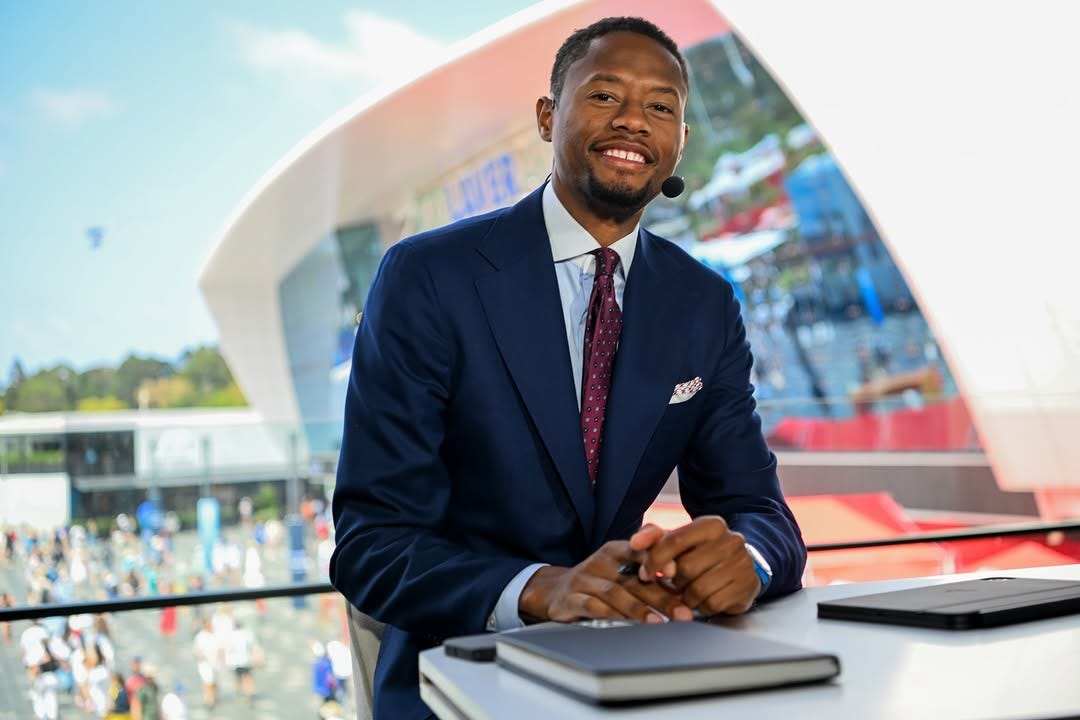
Whenever a tennis player retires, there’s always the fear that they’ll disappear into their private lives (totally fair, BTW) and we’ll never see them again. So when Chris Eubanks announced his retirement in November of last year, the collective sadness of a fan and industry favorite leaving the court was mitigated by the reassurance that he’d be staying very close to the game.
Eubanks, who’d already been working in broadcasting for a few years, is currently gracing our televisions at the Australian Open as a match and studio analyst for ESPN and is set to do the same for the next three slams. He’s recorded a few episodes for Andy Roddick’s Served podcast, where he gave his first interview about the decision to retire. He’s also the narrator of Ground Pass’s new docuseries Offseason, which follows up-and-coming players like Ethan Quinn and Eliot Spizziri. Not to mention that he regularly engages with fans on Twitter and Threads (the lord’s work) in an effort to provide context and clear up misconceptions about the game.
“I’m trying to make myself available to people who I feel are doing good work,” he told me a few days before heading to Australia. “I don’t like the clickbait-y, messy stuff, so I’d rather give my time to outlets that mean well, and if me coming on or talking to someone helps in any way, it’s like, why not?”
It’s that generosity and openness that has made the tennis world at large gravitate towards Eubanks over the years. Because his career story is so well known, I wanted to approach this interview a bit differently and get his take on all the takes out there. We spoke about how retirement’s going, but also touched on the tennis schedule debate, what he thinks has changed with player injuries, and the evolution of kit sponsorships (it turns out he’s just as invested in them as we are). You can check out our conversation below.
So I want to talk to you about a wide range of things, but let’s start with how retirement’s going?
It’s been unbelievable. I’m like, God, there’s so much more to life than playing tennis, and it’s so fun to be able to explore that. You know, Murray talked about it on The Tennis Podcast, he said something about how when he was playing, he never really had an appreciation for the things that he had accomplished because he was always looking for the next thing and the next thing. Granted, I’m no Andy Murray, I didn’t have that career, but I was the same way. Even after my run in 2023, my mind went straight to, I gotta do this again. It was like, if I don’t do it again, then what? So you don’t really take a step back and take stock of those things when you’re playing. The moment I decided I was done, everything started to hit me, where I thought back and was like, Wow, that’s insane, I can’t believe that actually happened. I just have a much greater appreciation for my career as a whole, the things that I was able to accomplish, and even more admiration and respect for the players who are able to do it at the absolute highest level week in and week out. Those guys are different animals. But I also just have a different outlook on life. My whole worth, as far back as I can remember, has been tied up in winning or losing a tennis match. Now it’s not, and it feels amazing. It’s like a weight’s been lifted off my shoulders. I got to watch some of the players train in the off season in Boca and I was like, Yeah, I do not want to be doing this and I’m so glad that I’m not.
How long before you made the announcement did you start thinking about retiring and what was driving that?
It wasn’t something that had been building in my mind for a while, but my frustration with tennis was definitely growing. I played in Asia and then went to France [for the ATP Challenger Roanne] and it all kind of came to a head there. I hit a point of being super frustrated on court and I started to realize that I wasn’t being myself off the court either—that had been happening for a while. I was starting to isolate a lot because I wasn’t winning as many matches as I wanted to. I wasn’t playing well, I wasn’t smiling on the court, I just wasn’t in the best place. But for a while, my focus was on doing something to fix it. I felt like I needed to win more and was obsessing over what I was doing tennis-wise that was causing me to lose. Because I believed that if I could just win, I would feel better, but it didn’t work like that. I was just digging myself a deeper and deeper hole, not wanting to talk to people, digging into my stats and my matches like crazy, I was so dug in. And then when I had the realization of, I think I’m just over it, I don’t want to do this, I was like, Oh, wow, I think I’m on to something there. I didn’t like the person that I was becoming and when I realized I just didn’t want to do it anymore, accepting that that was okay was probably the hardest part.
Right, especially when you feel like you’re still capable and there’s not something physically preventing you from continuing.
Exactly, and I felt like I was having great practices and doing all the right stuff. But, mentally, I’d just get on the court and struggle to find that same fire and spark. I wasn’t letting things roll off my back easily either, like if a guy gets a let cord at a big point it would frustrate me instead of just being like, Oh, that’s lucky. That’s what I was doing for all of ‘23, I was just laugh those things off. I hadn’t been laughing for the last year, so it was a much more stressful time.
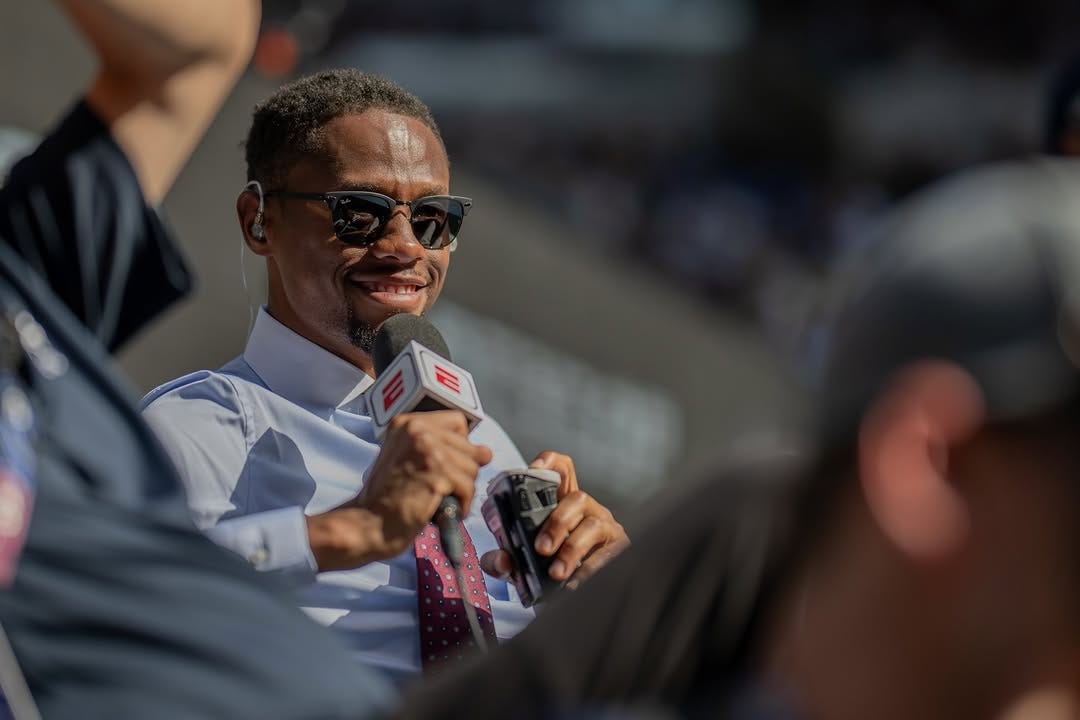
I know some players can struggle with what to do after they stop playing but you were set up really well for this phase since you’ve been commentating for a while. What can you share about your focus for this next year?
Yeah, as of right now, I’ll be commentating for all of the slams. I’ll jump on Roddick’s pod because I just love hopping on there with him and talking about the sport. There are a couple of other things still in the works—I’ll be doing something with Tennis Channel, for example. But I’m also just excited about all the other stuff I’ll now have time to do.
Yeah, is there anything completely unrelated to tennis that you’re looking forward to doing more?
Reading [laughs]. I started reading books again as soon as I stopped playing, a lot of finance and history books, which I’m really into. I read two books by Andrew Ross Sorkin—1929, about the Great Depression, and Too Big To Fail, about the 2008 housing collapse. I started golfing a little bit, and I think that’ll probably be the thing that I wake up and do when I’m home to kind of replicate the training structure I used to have. I think now it’ll probably be: wake up, go to the gym, and go hit at the range.
Sign up for a paid subscription to get Chris’s thoughts on the tennis schedule, the shifting sponsorship landscape, player injuries, and the gap between fan discourse and player reality.
