Beauty brands are sleeping on tennis—Mecca isn’t
Outside of sunscreen, beauty brands are largely MIA in tennis. Mecca's partnership with the Australian Open underscored why that’s a missed opportunity.
Mecca—which is essentially the Sephora of Australia and New Zealand—has quickly become a case study in how beauty brands can meaningfully get involved in tennis.
Although fashion brands have flocked to the sport in droves in recent years as tennis has grown in popularity, beauty brands have remained largely on the sidelines. Yes, nearly every tournament has an SPF sponsor like La Roche-Posay or ISDIN, but for the most part, it ends there. With so many beauty brands getting involved in other sports, it’s puzzling that they’d pass on one where skin is heavily on display, suncare is central, and many players treat the court like a stage for self-expression.
The problem isn’t that beauty doesn’t fit in tennis. It’s that brands have tended to approach it narrowly, defaulting to sunscreen while leaving much of the category underexplored. Mecca, by contrast, treated the Australian Open as a full-scale beauty moment.
“Women’s attendance and viewership at major sporting events is higher than ever, so we want to be where our customers are,” said Marita Burke, Mecca’s chief creative officer. “And there’s no better stage than the Australian Open—it’s a cultural moment that puts Australia front and center on the global map.”
The brand became the Official Beauty Partner (a first for any Grand Slam) of the Australian Open last year and returned this year as its Official SPF Partner too, replacing Bondi Sands. Its multi-pronged activations were hard to miss across social media, impressing normies, influencers, and players alike.
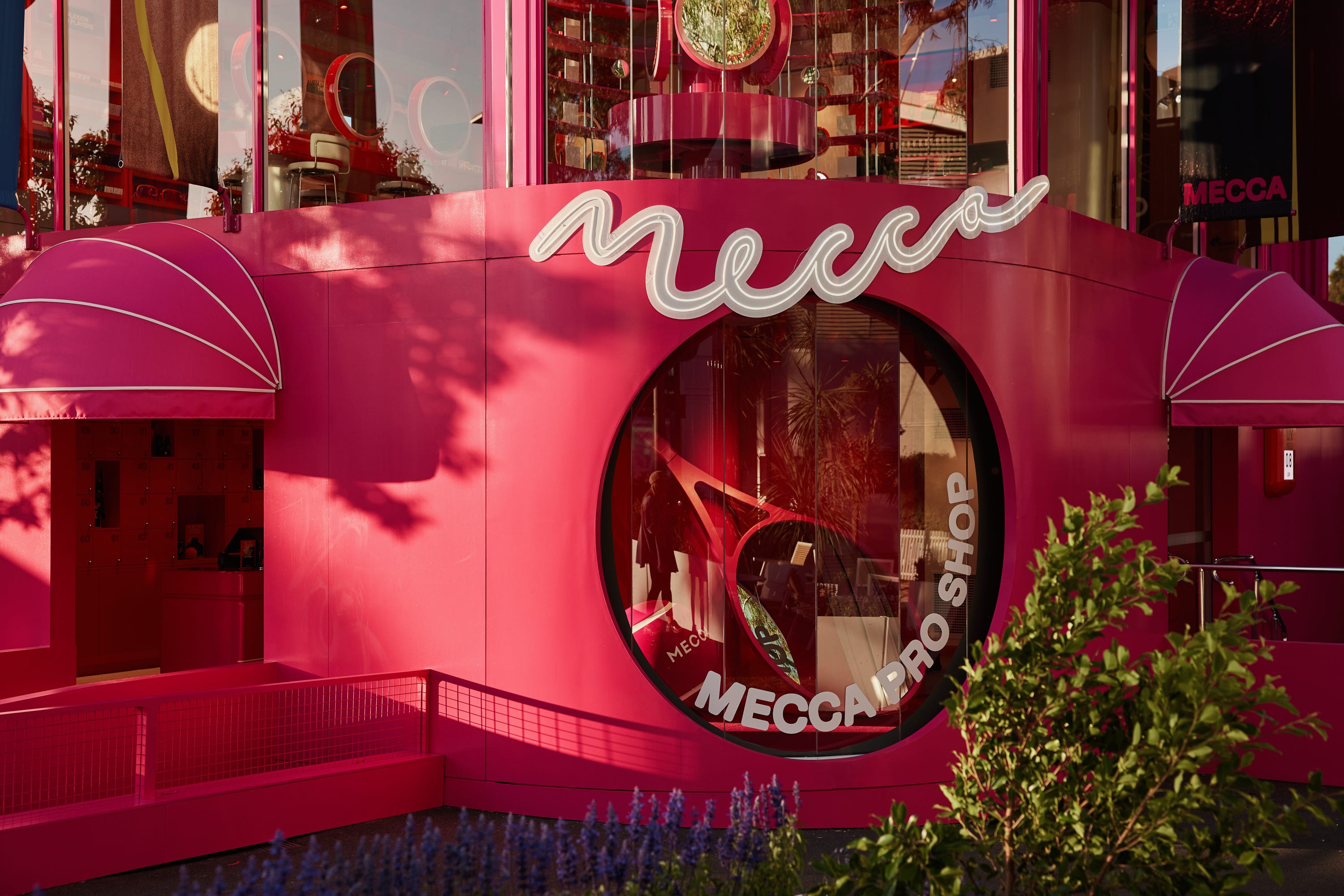
The standout was the aptly named Mecca Pro Shop, a three-story beauty shop in the heart of Melbourne Park that looked like a Barbie Dreamhouse. Inside, attendees could shop from an assortment of 680 beauty products, get express makeup and hair touch-ups, and consult with skincare and fragrance specialists.
“The product range was curated around how people actually experience the Australian Open—it’s hot, the days are long, and you’re constantly on the move, so we really thought about what beauty looks like in real life at the tennis,” said Burke, noting that many of the products available were mini-sized for portability.
Unlike pop-ups designed primarily for social content, the Pro Shop functioned like a fully operational retail environment—training consumers to associate tennis with beauty maintenance, not just sun protection.
Mecca also spiced up the often-boring sunscreen category with limited-edition packaging for its tentpole face and body products, To Save Face SPF50+ Superscreen and To Save Body SPF50+, along with branded keychains featuring mini sunscreens that attendees could clip onto their bags for easy reapplication. Sunscreen samples were handed out across 13 touchpoints, including an SPF Studio where visitors could shop larger sizes and receive sunscreen touch-ups throughout the day.
Media, influencers, and top customers were invited to watch matches from a special hospitality suite inside Rod Laver Arena called The Mecca Beauty Box, which Burke described as Mecca’s take on Wimbledon’s Royal Box.
“The vision was to create something intimate and elevated, but also impossible to miss,” she said. “We wanted people across the stadium to look over and think, ‘Ooooh, who’s in the Mecca Beauty Box today?’”
Players could get in on the action too via a private Mecca Lounge. First rolled out last year, it was expanded for 2026, offering players downtime to get their brows, lashes, nails, or makeup done, as well as facials, gua sha treatments, and post-sun consultations. It came close to having an on-site spa.
In a sport where players are largely responsible for their own beauty routines and appearance, the Mecca Lounge filled a gap tournaments have historically ignored.
“It’s not just about being serviced,” Burke explained. “Players can also learn from our specialists, picking up tips, techniques, and routines they can take home with them long after the tournament ends.”
While Burke couldn’t name names when I asked which players seemed to spend the most time there, she said many joked that they play the Australian Open for the Mecca Lounge. Open to both tours, ATP players stopped by as well, with one telling the team he “wanted to look good for his wife.”
“When players choose to spend their downtime with us and leave feeling cared for and valued, we know we’re doing something right,” Burke said.
Mecca’s scale and dominance in its home market obviously make this level of activation easier than it would be for a smaller brand or a one-off sponsor. But the takeaway isn’t so much about size as it is approach. Mecca treated beauty as infrastructure, not decoration.
That philosophy translated into a 360-degree presence on site that went beyond sales, impressions, and brand awareness. Rather than relying on logos, athlete endorsements, or one-off activations, Mecca treated beauty as a core part of both the fan and player experience.
“We want to show that beauty can truly live inside the sport—not as an add-on, but as something integrated,” Burke said. “Success for us means changing the rule book.”
In doing so, Mecca has repositioned tennis as one of the rare global sports where beauty can be experienced live, socially, and repeatedly across a two-week cultural moment. For beauty brands searching for relevance beyond influencer trips and Formula 1 paddocks, tennis may be the most underutilized stage left.
Thanks for reading! If you have tennis news or tips to share, email jessica@hard-court.com. For regular updates, follow Hard Court on Instagram.


Fun read! Loved it.
Brilliant case study on actual integration vs performative sponsorship. Mecca positioned themselves as infrastrucure instead of just slapping a logo on things, which honestly makes me wonder if other Grand Slams are paying atention. I remember trying to find basic skincare at Wimbledon last year and it was imposible outside of one SPF stand.