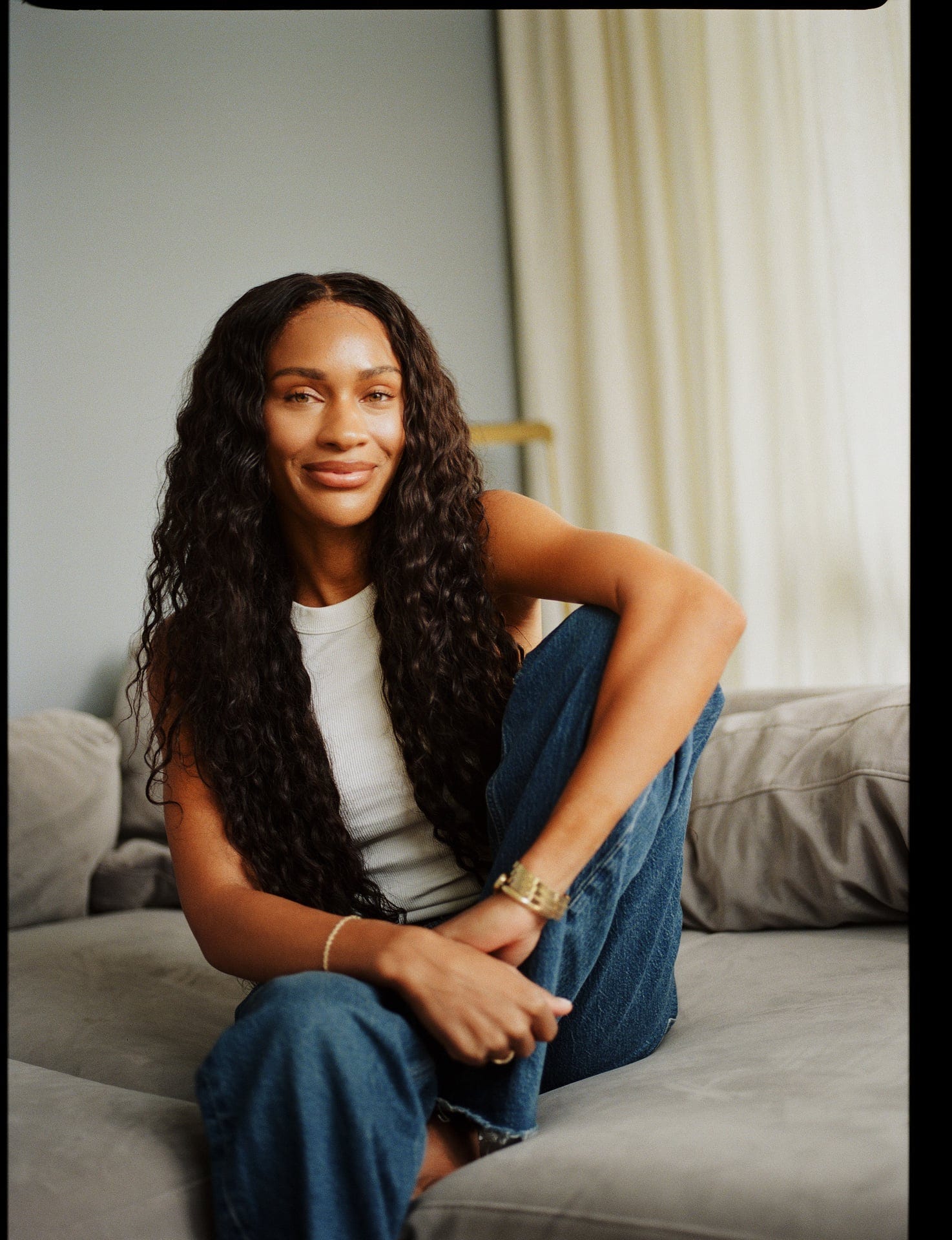
đš Ayan Broomfield on changing tennis culture from the stands
On bringing more Black women to tennis, the sportâs lingering racial dynamics, and the creators helping reshape its audience.
Ayan Broomfield is the type of person who greets you like youâre an old friend, even if youâve only just met. When we arrived at her New York apartment recently to film this interview, she welcomed us with big hugs and easy laughter as we got set up. Dressed in the kind of effortless uniform everyone wishes they could pull offâbarefoot in a simple white tank, deep-blue wide-leg denim, and long, perfectly tousled curls grazing her faceâshe curled up on the couch as we traded tennis gossip before easing into a more serious conversation.
A former Division I tennis player for Clemson University and UCLA, and the girlfriend of Frances Tiafoe, Broomfield has carved out a unique role within tennis cultureâa bona fide WAG, yes, but one whoâs using her growing influence to make a real impact on the sport. In 2025, Broomfield launched Ayanâs Aces, a program focused on bringing more Black women to tennis tournaments, after attending the Australian Open that year left her stunned by the lack of diversity.
âI know that Australia doesnât have the highest population of black people, but it was still jarring to go to an event five days in a row and not see any other women of color,â said Broomfield.
She posted a video about it on TikTok and it got the attention of Black Tennis Connect, a Charlotte, North Carolina-based organization focused on fostering a more inclusive tennis community. âIt immediately resonated with us because it articulated something we had already been thinking about and actively working on for several years,â said the companyâs co-founder, Raven Johnson. At the time, BTC had been building their Open Opportunity initiative, partnering with tournaments to create more accessible pathways for people from underrepresented backgrounds to experience professional tennis firsthand. They reached out to Broomfield just as she was starting to think about launching Ayanâs Aces and have since become a collaborative partner, helping to coordinate participant outreach, engagement, and logistics for many of the events.
Broomfield has now held Ayanâs Aces activations at nine sporting events, ranging from the US Open to the PGA Tourâs Cadillac Championship. They involve everything from distributing free tickets to Black womenâincluding 380 at this yearâs Miami Openâto hosting suites for Black influencers alongside brands like Cadillac, Grey Goose, and Lululemon, which signed Broomfield as a brand ambassador earlier this year.
âItâs been incredible to witness the impact of these events,â said Johnson. âEvery activation leaves people with this very tangible feeling of being seen, welcomed, and reflected within spaces that historically may not have always felt accessible or representative to themâparticularly for Black women and women of color.â
What makes Broomfield especially proud is seeing relationships that formed at her events continue long after the tournaments end. âA lot of the time, girls will message me after and say, âI met someone at your event and weâre hanging out and weâre best friends now,ââ she said. âThatâs what makes me so happy.â
I spoke to Broomfield about why tennis still struggles to feel welcoming to many women of color, how Ayanâs Aces evolved from a few extra tickets into a growing cultural movement, the increasing influence of creators in shaping the sportâs image, and the emotional complexity of building visibility while guarding her privacy. Watch or read the conversation below.
I want to go back to the beginning of your tennis playing years and what you were seeing coming up as a player. Was there anything during that time that maybe informed you eventually launching Ayanâs Aces?
So Iâm actually CanadianâI was born in Toronto. And one thing about being in Canada is that you have to play tennis six months out of the year indoors. So my first interaction with the exclusivity of tennis was more so through cost and access, because if you didnât have the money to play tennis, you wouldnât be able to practice for six months out of the year. And in that sense, I really realized that tennis is for a specific type of person, and if you want to play, you either have to be that good or have the funds to do it.
My parents always told my sister and I, look, we might not come from the best financial backgroundâthey worked very hard for us, but it was a very expensive sportâbut what you can make up for [that with] is your work ethic and hard work. So we were able to work with a lot of different sponsors and different clubs to offset the cost. But, if you donât have that, it is very difficult to play. And thatâs kind of what brought me to understanding a little bit more about the disparities in the sport of tennis.
Were you noticing the people in the stands and the lack of diversity there while you were playing?
Funnily enough, no. I think that when I was playing, I was so focused on the task at hand. And because there is such a high representationâwell, I wouldnât say highâbut there is a representation of women of color on court, I didnât notice it. I saw Serena [Williams], I saw Venus [Williams], I saw Sloane StephensâI saw all of these top players competing at the highest levels, winning week in and week out on the pro circuit. There were top juniors playing that were women of color. So on court I didnât notice it. It was when I started traveling with my significant other, and I was coming to the tournaments less as a player and more as a spectator, that I was looking around and was like, Wait, this feels a little bit weird, and I wanted to do something to fix it.
So when exactly did the idea for Ayanâs Aces first come to be?
It was two years ago at the Australian Open. And I will put a little bit of a caveat thereâI know that Australia doesnât have the highest population of black peopleâbut it was still jarring to go to an event five days in a row and not see any other women of color.
A lot of the time, I think [when] we talk about access in the sport [we talk about] cost, but there is also this essence of inclusion and even for me. Iâve been going to tennis tournaments for so long, [but] it is a little intimidating, and it does feel a little exclusive when you go to these tournaments and you donât see anyone that looks like you.
So I made a decision right then and there after a little TikTok video that I posted, which didnât get the best response, but I posted it and I saw that there were people who actually wanted to come to the tournaments. So initially I asked Frances, âDo you have any extra tickets that we can give away?â I think he had like four tickets. So I went into my DMs and sent [them] to girls in Australia who wanted to come, and from there it just grew more and more. I was able to get more access, more tournaments, more tickets, more suitesâuntil now, [when] itâs become this whole thing, so Iâm really happy with it.
I want to go back to that point you made about making a TikTok that didnât get the best response. What do you mean by that?
Yeah, so I made this TikTok, and it was basically referencing the fact that I didnât see any other women of color at the tournament, and the response that I got was either from people that were saying that I was being exclusive in a different, like, anti-racism way, by calling out the lack of diversity.
That was one end, and then the other end was women that were saying, We didnât know the tournament was going on, we didnât know that we were able to come to the tournament, we didnât know that we were allowed to come to the tournament, we didnât know that we belonged there at that tournament. So it was kind of a double-edged sword of just a lot of interactionâsome good, some bad. But it didnât stop me, I kept going.
Why was it important for youâdespite growing up being a playerâto focus specifically on bringing more Black women into the stands?
Good question. I feel like you shouldnât have to play the sport to be involved in itâthere are so many different avenues of each sport that you can kind of go into, whether itâs the fashion element, whether itâs just coming and taking pictures with your friends, or having a drink at the event. There are so many different ways to be involved in the sport, and it shouldnât rely on you specifically having a racket in your hand and being on court.
So I wanted to make sure that people were understanding that tennis is actually a really fun sport to attend, and that when you come to a tournament, there are things [to do] around the grounds. There are people that you can meet, you can build a community.
And it was most important for me to do it with women in particular, because thatâs where I saw the divide. I didnât feel like there were enough women coming to the matches, and so I wanted to make sure that I was [focusing] it [on] women of color and just being able to⌠Honestly, when I host Ayanâs Aces, my goal is to bring women to the tournament but I also really want them to build a community outside of tennis.
A lot of the time, girls will message me after and say things like, I met someone at your event and weâre hanging out and weâre best friends now, weâre going for drinks, weâre going to the movies, weâre doing all these different things. And thatâs what makes me so happy, because, yes, it should start at the sport and at the tournament, but I want it to grow into more of a community connection.
Yeah, I think thatâs really cool. As Iâve watched it grow, it seems like there are two types of events youâre throwing. On the one hand, there are events where youâre inviting anyone who wants to attend the tournament. On the other, there are more influencer-driven events. Why is it important for you to do both, and what kind of value does each one bring to tennis?
Thatâs a good question, and something that a lot of people ask me about. This is a good platform to explain it. When I first started Ayanâs Aces, my goal was to open it up to the community, and I just wanted anyone that wanted to come to a tennis event to be able to attend. What I did notice is that when I started partnering with brands, they were open and they wanted to support Ayanâs Aces, but they [were] also looking for a return on their investment, which I understandâto host a suite at a major tournament, it can cost upwards of $20-$30,000 for the night, between the hospitality, the food, the drinks, the travel, the transportation, and they want some sort of return, right?
And so when I do host these suites with brands, they want people there that also have some sort of platform. Initially, when I was talking to my management team, I was like, thatâs not really the goal of Ayanâs Aces. But after doing it a few times, I realized that, because [these women] also have a platform, they are also showcasing tennis [to their followers now too]. Most of their platforms, because they are all women of color, are [followed by] women of color. So being able to showcase tennis and sports and Ayanâs Aces on their [accounts] as well provides a unique opportunity to reach our community in a different way.
And then when I do work with a tournamentâfor example, I just worked with Miami Openâthey were able to work with me directly, and then I was able to open it up to the community [by providing tickets]. Thatâs when itâs really, really powerful and special to me personally. But I think there is a positive in having the other suites and allowing these [other creators] to showcase Ayanâs Aces and tennis on their platforms too.
Yeah, itâs just two forms of visibility that are equally important.
Correct.
One thing I thought about as I was preparing for this interview is that youâre creating this internal shift for the people that youâre inviting to the events, but thereâs also this external shift thatâs taking placeâIâm thinking about people who arenât necessarily part of Ayanâs Aces, but are in the stands as you help make them more diverse. Have you thought about what kind of impact that can have?
Yes, itâs funny because a lot of the times when the girls come, I do kind of give them a bit of a warning that they might get some weird stares and stuff, because I think it is⌠It shouldnât be jarring, but sometimes I think it is jarring to see 20 women of color walking through a tennis tournament. And sometimes weâre asked like, Are you part of the Real Housewives? Are you shooting a music video? We got asked that one time. I wouldnât say that itâs their fault, per se, but just the fact that itâs so shocking for them to see a group of women of color at a tennis tournamentâthat thatâs where their head goes to at firstâinstead of thinking, you know what, these people came to really enjoy the sport, enjoy the scenery, enjoy the tennis itself. So thereâs that.
First of all, itâs insane to me that that would be their response. And it also sounds like that could be an emotional experience. How do you deal with navigating that part of it?
Yeah, I try my best to curate a warm and inviting space for the girls that come, and I think that it is really nice for them to come and see other women that look like them. So I think that alone sets the tone.
But Iâve even been dealing with that for years. Sometimes when I go to tournaments, Iâll have my credential on and Iâll go to the entrance and people will be like, âThe workers entrance is over there,â and Iâm like, âWell, actually, my significant other is about to play on center court in five minutes. Iâm in the right line, I promise.â And itâs just like⌠itâs this subtle⌠itâs just uncomfortable, you know? And people donât really understand that part of it. Itâs not this whole big thing, itâs not that theyâre not letting me in. Itâs just that little [sense in your head that] you donât necessarily⌠[they] donât think you actually belong. Itâs just not pleasant, itâs not fun. And I think it is because there isnât enough representation of women of color at the tournament. So thatâs what Iâm trying to fix, because no one should feel like that. Everyone should feel like they can come to the tournament and be welcomed with open arms. Thatâs just the goal of my ancestors.
God, thatâs really upsetting to hear. How has the program grown since it first launched? It seems to have gotten a lot bigger, with more attendees and more events, and Iâve also seen you expand into different sports. Can you talk about that and what your larger dream for the program is?
Yeah. So it started with me using up Francesâs allotment of tickets and just sending them out through social media. But now weâve been able to work with the tennis tournaments themselvesâtheyâve seen that itâs something that needs to happen. Theyâve noticed that they want to support it, and theyâve been able to give us access to their suites and additional tickets. So we started with, what, five women and now at some tournaments weâre hosting 200-300 womenâat one tournament we even hosted 1,000 people. So that growth in access is really important to us. And then weâve also [expanded] outside of tennis into golf and F1, and these other spaces that I feel are underrepresented for women of color, which makes me really happy.
I think the end goal for thisâbecause tennis is a global sportâI want to make sure that this is something we can handle on a global platform. I think it would be really cool to host weeks with a brand at tournaments like the French Open, and bring girls from the States all the way there, or work with people who are already there. But I want it to be global, and I want it to be accessible every week of the year, at every major tournament, where people feel like they have access and can come [watch] tennis and learn more about the sport. Thatâs the end goal.
You mentioned earlier the financial roadblock for people of color in getting involved in tennis, but also maybe attending tennis tournaments. Have you learned anything else about what some of the barriers are for this audience to engage with tennis?
I just think itâs a lack of representation. I think even something as small as tennis fashion⌠When girls want to go to a tennis tournament and they say, Okay, what do I wear? Even something as small as going online and not seeing anyone that looks like them [posting from tournaments] or, you know, culturally, someone that has their fashion sense. They feel like they have to put on this front or kind of fit this cookie cutter mold of what they can actually wear or how they need to present themselves at a tournament.
This is why Iâm not really into social media that much. Iâm actually a very private person. I donât like postingâwhen I post something on Instagram, I turn my phone off. I canât handle it. But I do feel like I have a responsibility to be that role model for women that might not be playing tennis competitivelyâwhere they could look at a Coco or a Naomi or a Sloane. But itâs [about showing them someone who is] tennis-adjacent, and I feel like I have a responsibility to make sure that Iâm providing that access and knowledge to these ladies. I think I can do a better job at it, but I kind of take that on for myself.
I mean, I think youâre doing a great job just from my perspective. But on that note, I am interested in your thoughts as someone who is an influencer with a platform, what do you think is the role of people like yourself in shaping the future audience of tennis? And do you think creators have a duty to do more with it than just show up to tournaments?
You know, I actually hate the word influencer, like when someone says, oh, Ayan Broomfield and [puts] influencer beside it, I cringe every single time. I think thereâs such a weird stigma around that word. But I will say that I do like the [term] content creator, and Iâd much rather be called a content creator than an influencer. And funnily enough, I actually saw this video this other day, it was some tennis podcastâI couldnât tell you what the name isâbut they were talking about tennis influencers and they were like, Well, this person does influencing and sheâs really good at influencing, and that person does influencing and sheâs really good at influencing. And Iâd really rather them say, this person is a content creator, and sheâs really good at showcasing tennis fashion for people that are coming to tennis tournaments; this person is also a good content creator because she creates content about the travel [around] tennis, the behind the scenes, the food, the different places you can go; or this person creates tennis-specific content where she shows you how to hold your racket or technique. I wish there wasnât this stigma behind content creators in tennis, because I do think that theyâre moving the needle forward.
Not everybody is interested in watching people goâand especially with the menâgo and serve 130 mph a million times and hit a million aces. Itâs boring. Like at the end of the day, I think itâs a little bit boring. There are other things that you can do around tennis that can be showcased by a content creator. And our generation, especially younger people, they are driven by storytelling, theyâre driven by media and this [idea] of knowing who the person is behind the scenes.
So I think that tennis should dive more into content creation and allow each person thatâs playing to showcase more of their life. But I also think we should have more respect for the content creators, because theyâre bringing this essence of fun and passion and culture to the sport that I donât think a lot of players on tour want to or have the time to do. Theyâre focused on playing, theyâre focused on competing, they have a huge job. Theyâre not sitting there thinking about different ways they can create content after their match or the different algorithmsâthatâs for someone else. And thatâs where the content creators come in. I think a lot of them do a great job at it, and are bringing a completely new demographic of people to the sport, [which] is only going to grow the sport for everybody.
You mentioned earlier being a very private person and not feeling naturally comfortable putting yourself out there. How do you get over that feeling of vulnerability? And where is the line for you when it comes to what youâre willing to share and what youâre not?
I disassociate, I disassociate [laughs], because itâs not a natural thing to sit there and take a bunch of videos and photos of yourself, then spend an hour looking at them and editing them and breaking it down. Itâs not healthy and itâs just not fun for me. But I do understand that in order for you to have a platform and more access to certain things that you want to do, like Ayanâs Aces, you need a foundation there, and you need people that are going to engage. You need a community. So thatâs what drives me to continue making content.
I draw the line with family. I rarely ever post my family in things unless itâs something really cute, but itâs never something thatâs really intense. A lot of the time I draw the line with Francesâit depends on the type of content Iâm making with him. Iâll never do anything in his private moments. Iâll never showcase anything thatâs too behind the scenes, because this is his job, this is his occupation. This is fun for me, but this is his work. And even when I started making content, I will say I felt guilty and I felt bad, because I was like, Iâm in his world, I shouldnât be making content and benefiting from it financially. But at the same time, because now my world is merged [with] his, I have to realize that this is my world as well. Weâve been together for so long and this is my reality. So I try my best to separate the two, unless itâs something cute where weâre doing little couple things, but I like to give him space and his own place to feel comfortable. I donât want to be sticking a camera in his face 24/7, so itâs a fine line.
But I donât know, I try my best, but I definitely disassociate because social media is a crazy place and I donât want to ever allow it to change who I am at my core.
That sounds very healthy. Well, I think Iâve asked you everything I wanted, but is there anything else about Ayanâs Aces and what you want to do with it in the next few years that you want to leave us with?
My goal is to really make sure that it goes beyond tennis. I think there are a lot of spacesâwhether it is sports or fashionâthat could benefit from more diversity and inclusion. And I hope that Ayanâs Aces can go from being exclusively in sports into different areas where, for example, a company might say, You know what, we need to focus more on diversity, [letâs] bring in Ayanâs Aces as a collective, and that can help us get there. Because a lot of peopleâyou donât know what you donât know. And unless you have somebody that can speak to it, like myself, I think itâs hard to really incorporate it, especially if thatâs not your main audience or your main goal.
But one thing Iâve learned from Ayanâs Aces is that there are so many people that want to get into tennis. They want to learn more about it, they want to play and have more knowledge about it. And if we just [give] people the access and the inclusivity and make them feel warm and welcome at the tournaments, theyâll want to keep coming back.
Thanks for reading! If you have tennis news or tips to share, email jessica@hard-court.com. For regular updates, follow Hard Court on Instagram.


I wish she was on substack because I selfishly donât use any Meta owned social media platforms.
Fantastic interview. So many great points. Really excited to watch Ayan and her work continue to grow.