Changeover notes from Australian Open days 1-2
Coachella comes for the Aussies, a sprinkle of upsets, and kit sponsorship struggles.
If you’re new here (and there are a lot of you, hi!) you might not know that in the early days of Hard Court (a long six months ago) most of my posts were split into a few rotating sections. As things took off I started doing more long-form pieces, but I think the original format is still great for big tournaments where there’s an abundance of info to touch on. You can go home again after all.
The Replay
The Australian Open gets its own Coachella comparisons
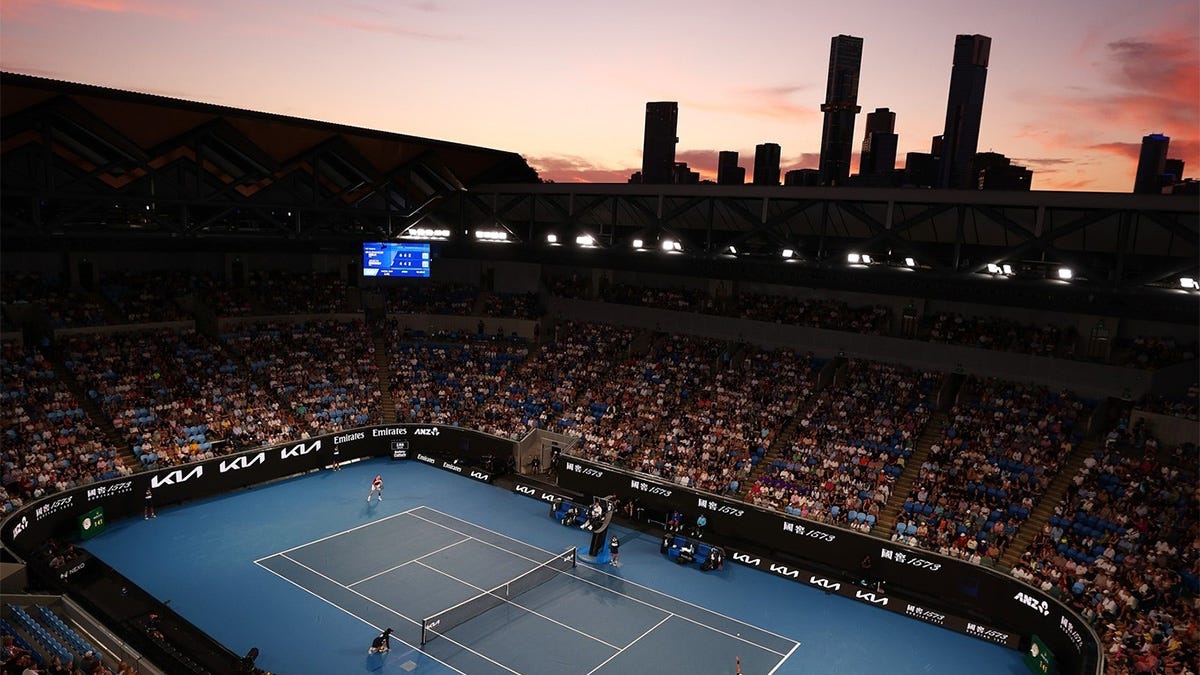
It was only a matter of time before the music festival vibes of the US Open seeped like a sticky Honey Deuce into other Grand Slams and, in Australia, they have officially arrived (some might say with a vengeance). Melbourne Park set its highest single day attendance record on Monday with 101,696 spectators, according to Melbourne newspaper The Age. Multiple reports said that on opening day, lines to get into the tournament took over an hour long and that transportation was in gridlock. Tournament director Craig Tiley responded on day two by removing turnstiles to speed up the process and increasing security and police presence to help manage the crowds.
Attendees took to Twitter to complain about the overflow of influencers and their poor “tennis etiquette,” while others lamented the fact that every single match had long lines (queues, for my Aussies and Brits) to enter.
Journalist and Served co-host Jon Wertheim tweeted, “This event is less a tournament than a tennis festival with some competition tacked on,” though he made it clear (“Who cares?”) his stance was neutral, later playing devil’s advocate to the naysayers and arguing that in the post-Big Three/Serena era making the “event itself the biggest start” is the way to go. Ideally, he wrote, a good percentage of the see-and-be-seen crowd would convert to true tennis fans.
I’m not yet convinced that the (largely) fashion and lifestyle influencers who show up to these events to take cute pictures and try Instagram-worthy themed drinks are paying enough attention to the on-court action to fall under its spell, however it’s hard to argue that more footfall is bad for a sport that—despite clearly growing in popularity—ranks 9th in sports viewership in the US and experiences less than half the amount of live viewing than football (soccer) does in the UK.
A sprinkle of upsets
We’re certainly not in Wimbledon 2025 territory when it comes to upsets yet but, as always, there have been a few biggies. A few that stood out:
The Columbia University student and two-time NCAA champion Michael Zheng knocked out world No. 53 Sebastian Korda in a five-set slog that lasted almost four hours. It’s both a bright spot for the 21-year-old Zheng and a bummer for Korda, who’s been plagued with injury over the last few years and had a stop-start career as a result.
World No. 60 Elsa Jacquemot beat world No. 20 Marta Kostyuk—who just had a great run in Brisbane—in a tight three-setter at the end of which Kostyuk rolled her ankle and tore a ligament. “[It’s] part of the sport," Kostyuk said afterward.
Jiri Lehecka, fresh in his new Wilson kit, was ousted in a shock of a match by the French Qualifier Arthur Géa, who was making his Grand Slam debut. He’ll meet Stan Wawrinka next in a battle of green vs. grown.
World No. 46 Nuno Borges was always going to be a tough R1 for world No. 8 Felix Auger-Aliassime but, barring previously disclosed injuries, no one ever expects a match to end in retirement. After being down two sets to one, FAA had a medical timeout and ultimately retired due to cramping. “It became very difficult to be competitive at this level,” he said afterwards. “I don't want to just be standing there like a punching bag.”
But the most talked about upset might be determined by the amount of WhatsApp messages I woke up to from colleagues in Australia insisting I needed to watch it, stat. That would be world No. 99 Alycia Parks defeating the ultra-popular young star and world No. 49 Alex Eala—who created a lot of commotion on the grounds—in three sets after getting bageled in the first. Having watched Eala defeat Clara Tauson live last year at the US Open, where Eala’s massive Filipino and south east Asian fanbase booed Tauson’s every move, Parks showed massive resilience to bounce back.
Kitted
The kits aren’t coming easy
Quentin Halys came out swinging against Alejandro Tabilo, who he beat in three sets that weren’t really competitive until the end. He was recently dropped by FILA and his management team told me that they’re hoping some good results will make him a more appealing get for other brands as they struggle to find a new sponsor. I can’t underscore enough how tough it is out there on the sponsorship front these days for anyone not in the top 20.
Product-only deals are often the only hope. Case in point: Reilly Opelka, also dropped by FILA, is now wearing the Italian luxury brand SEASE in what I’m told is a product-only deal. Barbora Krejčíková is also receiving free product from Vuori now.
Quick hits
What to consume while you wait for more tennis
A docuseries about the tennis off-season: My good pal Anastasia of Ground Pass put together this docuseries in roughly two months (my favorite kind of insane) and got the one-and-only Chris Eubanks to narrate it. Watch the first episode now.
An interview with “Killer” Cahill: The tennis writer Simon Cambers spent time with Darren Cahill for Esquire Australia in an effort to unearth what makes him such a damn good coach.
Thanks for reading! If you have tennis news or tips to share, email jessica@hard-court.com. For regular updates, follow Hard Court on Instagram.


