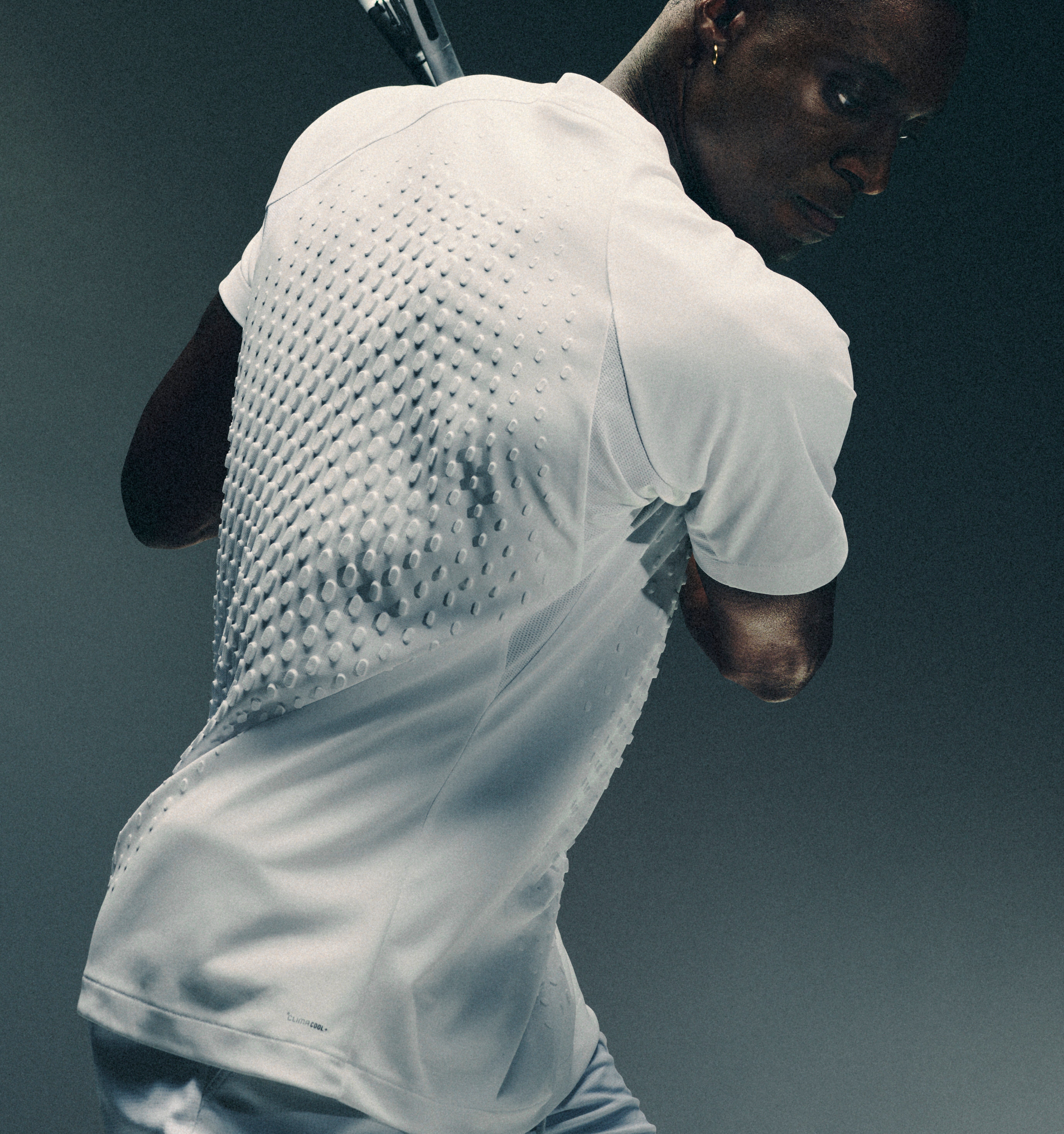
As tennis heats up, Adidas bets on cooling technology
The brand's new Climacool+ fabric will debut at Wimbledon, alongside custom kits for players like Elina Svitolina, Félix Auger-Aliassime, and Karolina Muchova.
The world is getting hotter and it’s playing out on center court.
Tennis has spent the last several years adapting to increasingly extreme conditions, from the Australian Open’s Heat Stress Scale to record temperatures at Wimbledon and sweltering afternoons in New York—not to mention the sauna we all just lived through in Paris. Tournament organizers have responded with cooling breaks and expanded heat protocols.
But apparel brands are betting they can be part of the solution, too, as they race to develop fabrics that better regulate body temperature, improve breathability, and help athletes perform in increasingly challenging conditions. Adidas is the latest to join the effort, unveiling a new cooling technology called Climacool+ that it believes can give players an edge as the sport confronts a warmer future.
An evolution of Adidas’s Climacool line—which debuted in 2002 amid a wave of innovation in moisture-management fabrics led by Nike’s Dri-FIT—Climacool+ incorporates what the company describes as “advanced cooling features that change the structure of the garment, creating airflow exactly where athletes need it most,” according to Margherita Raccuglia, Adidas’s Global Director of Innovation, Athlete Performance. Among them are embossed 3D structures which are strategically mapped to areas of the body that generate and retain the most heat. “This creates a gap between the skin and the garment, allowing for more circulation and maximizing sweat evaporation,” Raccuglia explained.
The technology is making its commercial debut in Adidas’s new all-white London Collection, which launches today ahead of Wimbledon. While the cooling technology is new, the overall aesthetic draws on the brand’s tennis heritage. According to Annette Steingass, Adidas’s Senior Director of Specialist Sports, images of Steffi Graf and Anna Kournikova repeatedly surfaced on the design team’s mood boards, inspiring both the body-contouring shape lines and the relaxed, cropped silhouettes that draw from the brand’s 1990s archive.
Five players—including Karolina Muchova, Elina Svitolina, Félix Auger-Aliassime, Maria Sakkari, and Alexander Zverev—will wear custom looks incorporating the new fabrication. According to Steingass, Adidas already knew which silhouettes each athlete felt most comfortable competing in, allowing the team to focus on refining the garments through body scans and multiple rounds of fittings. The resulting designs are as varied as the players themselves. Svitolina's look, for example, is a polo-collared dress featuring raw edges, bonded tapes, and laser perforations. Muchova, meanwhile, will wear a cropped polo and shorts, reflecting her preference for slightly looser silhouettes. The top combines sweat-concealing fabric with power mesh inserts, bonded seams, and an engineered collar designed to increase airflow around the neck.
“When we create product, especially apparel, you want the athlete to look great but you also want to make sure that you’re genuinely problem-solving for them—that the garments you give them perform, and don’t cause distractions or get in the way,” said Steingass.
The focus on thermoregulation for this new collection emerged directly from athlete feedback. “They were always telling us that, whenever the sport intensified or the temperatures rose, their movement would feel restricted because of the sweat accumulation, which also limits airflow and leads to overheating,” said Raccuglia.
The prototypes were tested both in Adidas’s climate chamber—which can simulate high heat and humidity—and in real-world competition. In fact, Sebastian Sawe, the Kenyan runner who recently became the first athlete to run a record-eligible marathon in under two hours, sneakily wore the technology during his historic performance. “There was no visible sweat when he reached the finish, which was a big proof point for us,” said Raccuglia.
I reviewed photos from Sawe’s finish and it’s true there were minimal sweat marks. Still, a slinky racing singlet is not a direct comp for what tennis players wear on court.
But Adidas is confident the results will translate. According to Raccuglia, players who tested the fabric reported increased airflow, less sticking, and greater freedom of movement. One athlete, she said, returned from a run shocked by how dry the garment felt despite the intensity of the workout. But lab testing and training runs can only tell you so much. The real proof point will come at Wimbledon, where players will spend hours competing under the pressure, movement, and heat that inspired Climacool+ in the first place.
Thanks for reading! If you have tennis news or tips to share, email jessica@hard-court.com. For regular updates, follow Hard Court on Instagram.
Hard Court is built on independent reporting and analysis. If you refer to our content in your work, please cite the source. I really appreciate it!


